

The September Chill: Why Your Three-Season Room is Losing Its Appeal
You step out into your three-season room with a morning coffee, only to realize the space is already too cold to enjoy comfortably. At Adams Heating & Cooling, our team hears this exact frustration from homeowners every fall. Addressing drafty Kalamazoo sunrooms before the first hard frost is a priority if you want to keep using that extra square footage as the seasons change. The rapid transition from mild late-summer days to chilly early-fall evenings happens quickly in Michigan. One week you are enjoying the breeze with the windows open, and the next, you are shivering while watching the autumn foliage peak.
If you are looking for reliable heating solutions to reclaim your space, it is time to explore dedicated options. Abandoning a favorite living area for half the year is a frustrating reality for many homeowners, but in our experience, it does not have to be permanent. Exploring dedicated heating methods before the freezing weather sets in permanently gives you the chance to winterize the room properly. Modern HVAC technology offers targeted ways to reclaim this square footage without overhauling your entire house or driving up your monthly utility bills. The key is acting during the September pre-first hard frost window, ensuring your home is fully prepared before the winter weather forces you indoors.
The Unique Physics of Heating an Uninsulated Michigan Sunroom
Understanding why your sunroom is so difficult to heat requires a look at the architectural design of the space. In our years of servicing Kalamazoo homes, we've seen that three-season rooms were originally designed for cross-ventilation and enjoying the outdoors without dealing with insects or rain. They were not engineered for thermal retention. When you try to warm up a space that consists primarily of glass, you are fighting against the basic physics of heat transfer.
Understanding Your Heating Load
When our technicians evaluate a space, we use the term heating load to describe the amount of heat energy required to maintain a comfortable indoor temperature. The heating load of a sunroom is drastically different from a standard interior bedroom. Standard walls are packed with insulation, providing a high thermal resistance (R-value). Glass windows, even double-paned ones, offer a fraction of that resistance. Because of these large windows and minimal wall insulation, heat escapes rapidly into the cold Kalamazoo air.
Overcoming this continuous heat loss requires a constant, highly efficient heat source. Intermittent blasts of warm air will not work; the moment the heat stops blowing, the room will immediately begin to cool down again. Treating a sunroom like a standard interior bedroom will inevitably lead to comfort issues, condensation on the windows, and a space that always feels slightly drafty.
The Ductless Advantage
Because the thermal characteristics of a sunroom are entirely unique, the heating approach must also be unique. This is where ductless mini-split systems excel. By treating the sunroom as an independent zone with its own specific heating load, you can provide the exact amount of continuous warmth required to offset the rapid heat loss through the glass, without affecting the rest of your home.
Why Extending Central Ductwork is a Costly Mistake
A common assumption we encounter during early fall heating tune-ups is that the easiest way to warm up a chilly sunroom is to simply cut a hole in the floor or wall and run a new duct from the existing central furnace. While this seems like a logical, low-barrier fix, our team regularly sees how it becomes one of the most problematic approaches you can take for your home's overall comfort and efficiency.
The Problem with Sizing and Static Pressure
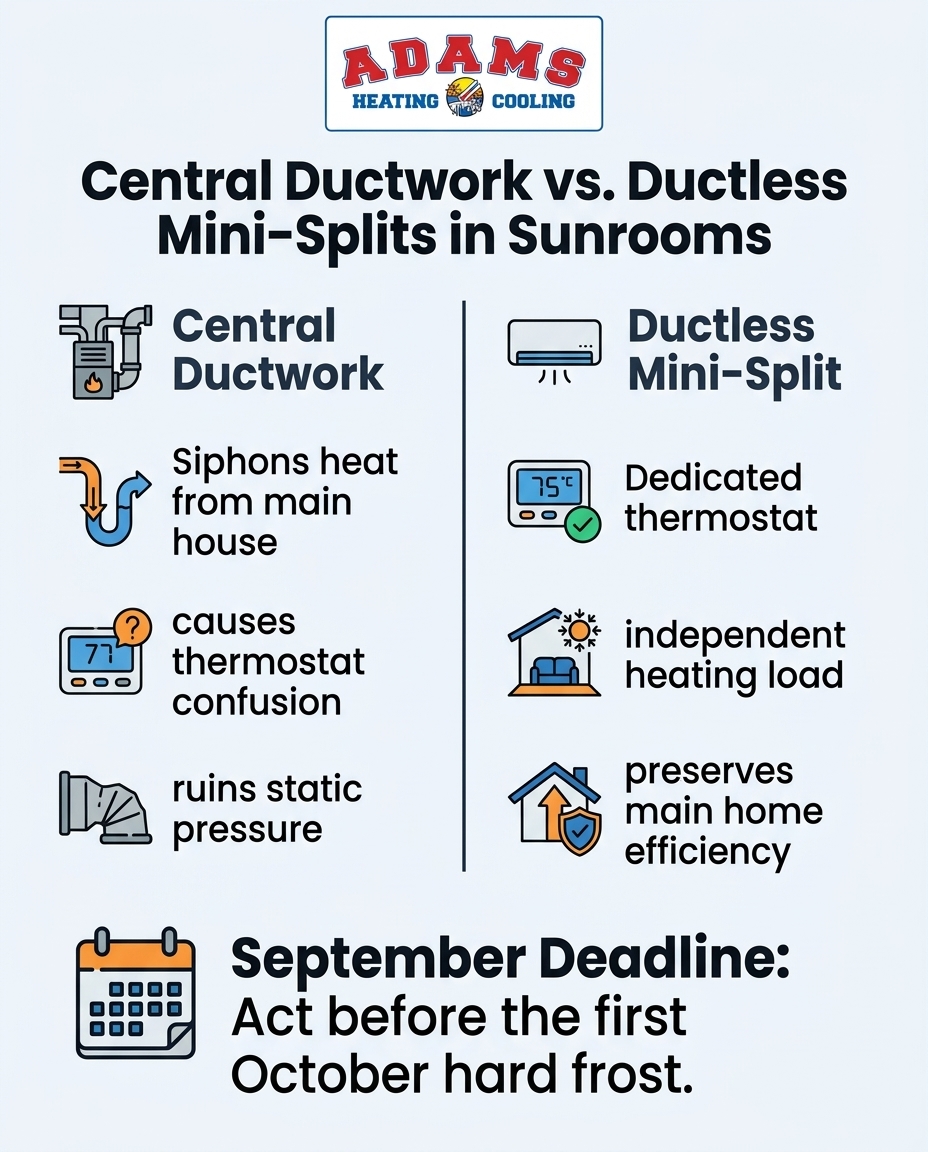
Your central HVAC system was carefully sized for the original enclosed square footage of your home based on a calculation called a Manual J load calculation. The blower motor is calibrated to push a specific volume of air through a specific network of ducts. This creates a balanced static pressure. When you open a new duct into a high-loss sunroom, you disrupt that carefully balanced pressure. The new vent acts like a leak, siphoning warm air away from your main living spaces. You will likely notice that the bedrooms or the living room suddenly feel colder because the warm air is traveling the path of least resistance into the sunroom.
The Thermostat Confusion Cause
Furthermore, your home's primary thermostat is located in a central hallway or living room. It cannot accurately read the temperature of a thermally distinct sunroom. If the thermostat is set to 70 degrees, it will shut off the furnace as soon as the hallway reaches 70 degrees. Meanwhile, the sunroom, with its massive heating load and rapid heat loss, might still be sitting at 55 degrees. The central system simply does not know the sunroom is cold.
The Inevitable Solution
Extending ductwork ruins the main home's heating balance, leading to overworked equipment, higher utility costs, and severe uneven comfort. If you are already struggling with fixing temperature fluctuations in your home, tying a sunroom into the central ductwork will only make the problem worse. The only effective solution we recommend is to separate the sunroom from the central system entirely.
• Extending Central Ductwork — Impact on Main Home: Siphons air, lowers static pressure, causes cold spots. — Thermostat Control: Controlled by hallway thermostat; sunroom remains cold. — Efficiency in a Sunroom: Very low. Furnace short-cycles before sunroom is warm.
• Dedicated Ductless System — Impact on Main Home: Zero impact. Preserves main home's heating balance. — Thermostat Control: Independent thermostat located inside the sunroom. — Efficiency in a Sunroom: Very high. Matches the exact heating load of the room.
The Limitations and Risks of Relying on Space Heaters
When the chill first sets in, our technicians often notice homeowners dragging a portable space heater or an electric baseboard out of storage. Space heaters seem like a quick, low-barrier fix for a chilly evening in early autumn. However, they are not a viable long-term strategy for maintaining a comfortable living space throughout a harsh northern winter.
• Severe Energy Inefficiency: Most portable space heaters rely on electric resistance heating. This means they generate heat by passing electricity through a wire, which is a 1-to-1 energy transfer. For every unit of electricity you pay for, you get exactly one unit of heat. In contrast, modern heat pumps transfer ambient heat from the outside air, often delivering three or four units of heat for every unit of electricity consumed. Running a space heater constantly to fight the draft in a sunroom will cause a massive spike in your monthly energy usage.
• Safety Hazards: Running portable heaters unattended or for extended periods poses significant safety risks. Residential electrical circuits are not always designed to handle the continuous, high-amperage draw of a 1,500-watt space heater. This can lead to overloaded circuits, frequently tripped breakers, and degraded wiring over time.
• Uneven Temperature Distribution: A space heater only warms the area immediately surrounding it. If you sit directly in front of it, you might be uncomfortably hot, while the rest of the room remains freezing. This localized, uneven heat contrasts sharply with the comprehensive, wall-to-wall climate control required for true comfort.
While a heavy-duty space heater might survive a mild October evening, it will fail completely during a deep January freeze. If you want to use the room reliably, securing a permanent solution during the September pre-first hard frost window is highly recommended.
Isolating the Heating Load with Dedicated Ductless Technology
The most effective way to heat a sunroom is to acknowledge its unique thermal properties and isolate its heating load from the rest of the house. Ductless systems operate completely independently, providing zoned temperature control specifically tailored for the sunroom.
How Zoned Heating Works
A ductless system consists of an outdoor compressor unit and an indoor air-handling unit mounted high on the wall or ceiling. Because there is no ductwork required, the installation process is incredibly non-invasive. It requires only a small, three-inch wall penetration to connect the refrigerant lines and electrical cables between the indoor and outdoor units. This means you do not have to tear open ceilings or walls to run bulky metal ducts.
Advanced Compressor Technology
The secret to their efficiency lies in the inverter-driven compressor technology. Traditional central furnaces operate on a single speed: they are either blasting at 100% capacity or completely turned off. An inverter-driven compressor acts more like the gas pedal in your car. It ramps up and down smoothly, continuously adjusting its output to match the exact heat loss of the room at any given moment. If the sun comes out and warms the room naturally, the system dials back its energy usage. As the sun sets and the temperature drops, it gently ramps up to maintain a perfectly consistent temperature.
Beyond winter warmth, these systems offer dual functionality. They provide robust heating in the winter and highly efficient cooling in the summer, making your Kalamazoo sunroom a true year-round retreat.
Navigating Local Climate Zones: The Importance of Cold-Climate Heat Pumps
Not all heat pumps are created equal, and choosing the wrong equipment for a northern climate will leave you shivering. Standard heat pumps are fantastic for mild climates, but they begin to lose their heating efficiency as the outdoor temperature drops below freezing. When the winter wind starts howling off the lakes, a standard unit simply will not be able to extract enough heat to keep a poorly insulated sunroom warm.
The Cold-Climate Difference
This is where cold-climate heat pump technology becomes critical. These specialized systems are engineered with enhanced compressors and advanced refrigerants that can extract ambient heat energy from the outside air even at sub-zero temperatures. The physics might sound impossible, but even air at negative 10 degrees Fahrenheit contains heat energy that can be captured, compressed, and transferred indoors.
As local experts who understand the architectural quirks of Michigan sunrooms, the team at Adams Heating & Cooling provides tailored Daikin ductless options designed specifically to handle deep freezes. Choosing the right equipment ensures the sunroom remains a cozy retreat even during the harshest blizzards, rather than just surviving the milder weeks of autumn.
Rebates and Incentives
Because these systems operate with such high energy efficiency, upgrading your sunroom's heating may qualify for various incentives. Qualifying high-efficiency heat pumps may be eligible for general federal tax credits or local utility rebates. We always advise homeowners to verify current programs with their utility provider or a tax professional, as these incentives can help offset the initial investment of winterizing your space.
Frequently Asked Questions About Sunroom Heating in Michigan
Can a mini split efficiently heat a 3-season room?
Yes, provided it is properly sized for the room's specific heat loss and features cold-climate technology. A mini split isolates the heating load, meaning it evaluates the temperature of the sunroom independently from the rest of the house. By using inverter technology, it provides a steady, continuous stream of warmth that offsets the heat escaping through the glass.
How do you winterize a 3-season room?
Beyond adding a dedicated heat source, winterizing includes upgrading weatherstripping, sealing drafts around window frames, and adding thermal window treatments. Heavy thermal curtains can drastically reduce the amount of heat lost through the glass at night. Adding an insulated rug over concrete or uninsulated flooring also helps retain the warmth generated by your heating system.
What is the most efficient way to heat a sunroom?
A dedicated ductless heat pump is the most energy-efficient method, as it transfers heat rather than generating it through electrical resistance. Unlike space heaters that consume massive amounts of electricity to create heat, a heat pump simply moves existing heat from the outdoors inside. This process uses significantly less energy, keeping your utility bills manageable throughout the winter.
Why shouldn't I extend my central heating to a sunroom?
It destabilizes the static pressure of the HVAC system, overworks the furnace, and creates severe temperature imbalances in the main living areas. Because your central thermostat is located in the main house, it will never accurately read the temperature of the sunroom. You will end up with a freezing sunroom and a main living area that is constantly starved of proper airflow.
How late into the fall can I wait to install a sunroom heater?
It is highly recommended to complete installations in September, before the rapid temperature drops of October make the room unusable and contractor schedules fill up. Waiting until the first freezing night means you will likely spend several weeks unable to use the space while waiting for an installation appointment. Proactive planning ensures uninterrupted comfort.
Secure Your Sunroom's Comfort Before the Freezing Weather Arrives
The window to act is closing quickly as the September pre-first hard frost timeline approaches. Waiting until the snow falls means abandoning a valuable part of your home for months, or resorting to dangerous and inefficient space heaters to fight off the chill. Isolating the sunroom's heating load with a dedicated, cold-climate ductless system is the only proven way to ensure reliable, year-round comfort without disrupting the balance of your main central HVAC system. Before the freezing weather settles in for good, consult with the local experts at Adams Heating & Cooling to evaluate your specific sunroom layout. A proper load calculation and a tailored ductless solution will allow you to enjoy your sunroom comfortably, no matter how harsh the Michigan winter gets.
Customer Testimonials

In the past 18 months, Adams has installed a new Amana air conditioning system, and new filtration and humidification systems at my home. The installers were all very courteous, professional and knowledgeable. Their work was simply superb... reasonably priced, and performed on time and to perfection! I enthusiastically recommend Adams, without reservation!
As usual, Adams Heating and Cooling exceeded our expectations. The quote was done in a timely manner, pricing was fair, installation was quick and the job was done right! Rob is great to work with. Adams is first on our list!
Called these guys off of a referral from a friend. Home furnace failure in sub-zero temperatures, late at night. Dan was there in an hour. Friendly, polite, professional and most importantly, very competent. Diagnosed and fixed the problem in under an hour. After hours 24/7 pricing was surprisingly reasonable. This outfit gets straight A+ from us.
Excellent service! We had them replace our heater, AC, and water heater as a package deal. They even helped with financing as it was a large expense to address at one time. It left us with peace of mind that all the mechanicals in our home were new!
They have always been there for us and did so again by responding quickly to put in a new furnace after a lighting strike caused a power surge. In addition, their electrician came by to help with other issues caused by the strike. Everyone we work with from the who answers the phone to who shows up to complete the work are polite, pleasant and professional! And quick to respond and on time!
From the service call to the installation with Dan, Dave, and Daniel… our experience was top notch. They quickly came out, identified the problem, and installation of our new unit took less than 3 hours. Can’t recommend Adams enough!
Dan, Dave and Mike were phenomenal! Very patient, listened to my questions/concerns, and made sure that everything was working and that my Nest was working correctly, before leaving. Thank you so much for your service!
Service was excellent! Had a new furnace installed. The technicians did a wonderful job and completed the installation quickly. Mike answered my questions and followed up to verify the worke done. I was charged just as I was quoted. Have used Adam's for repairs in the past and I'm always pleased. Great work!
I had a boiler and water heater replacement/upgrade. I went from an 84% efficient boiler to a 95% efficient. I dont recall the water heater's efficiency. That was upgraded to an indirect water heater. Josh and Brad did a great job. The work looks great. The boiler and water heater work as to be expected. Their customer service is excellent. I will definitely be calling then when my basement remodel is ready to start.
I have had Adam's Heating and Cooling out at my house before, so I called them for some gas line work. The estimator was very helpful and let me know the best way to be ready for when the work is scheduled so they can test the generator after they install the gas line to the meter and also let me know how to take care of another issue I had that would be helpful. I look forward to getting this work done and working with them.

Financing
Flexible financing options are available to help you get the comfort you need without the upfront financial stress.