

Why Standard Heating Systems Struggle in Sprawling Portage Homes
Are you constantly adjusting the thermostat because half of your house is sweltering while the other half feels like an icebox? Evaluating the ROI of modulating furnaces for large Portage estates starts with understanding exactly why your current system is failing to keep up with the demands of your property. In our years of servicing the Kalamazoo and Portage areas, our team at Adams Heating & Cooling consistently sees standard heating equipment face an uphill battle in sprawling, 3,000+ square foot homes. Traditional furnaces operate on a simple binary premise: they are either blasting heat at full capacity or they are completely turned off. This rigid cycle creates a rush of warm air that quickly satisfies the thermostat located in a central hallway, prompting the system to shut down long before that heated air can reach the distant wings of the house.
For homeowners managing the unique layout of Portage Estates large-footprint homes, this short-cycling behavior is the root cause of chronic discomfort. The sheer volume of space requires a more sophisticated approach to air distribution. When a standard system shuts off prematurely, the air in the furthest rooms grows stagnant and cold, forcing you to crank up the temperature and waste energy just to make a distant bedroom livable. The decision point for many homeowners comes down to whether they should endure another season of uneven temperatures or upgrade to a premium, fully modulating system during a pre-fall replacement.
If you are ready to permanently solve these complex airflow challenges, securing professional heating services is the critical first step. An expert assessment can determine whether a Daikin furnace installation is the right fit to restore consistent comfort across every square foot of your property.
The Short-Cycling Dilemma in Large Square Footage
To fully grasp the limitations of a standard furnace, it helps to look at the physics of airflow in a large estate. When a single-stage furnace kicks on, it pushes a high volume of air through the ductwork very rapidly. In a smaller home, this works perfectly fine. However, in a sprawling property, the duct runs are significantly longer. The central areas heat up quickly, satisfying the thermostat's set point, and the system powers down.
The consequences of this rapid cycling include:
• Severe temperature imbalances: Rooms closest to the furnace become uncomfortably hot, while rooms at the end of the ductwork remain freezing.
• Increased mechanical wear: The constant starting and stopping puts immense strain on the blower motor and heat exchanger.
• Wasted energy: Much like a car driving in stop-and-go traffic, a furnace consumes more fuel during the initial startup phase than it does while running continuously.
Upgrading your equipment addresses these specific mechanical shortcomings, transforming how your home consumes energy and distributes warmth.
Breaking Down the Efficiency Equation: AFUE and Energy Savings
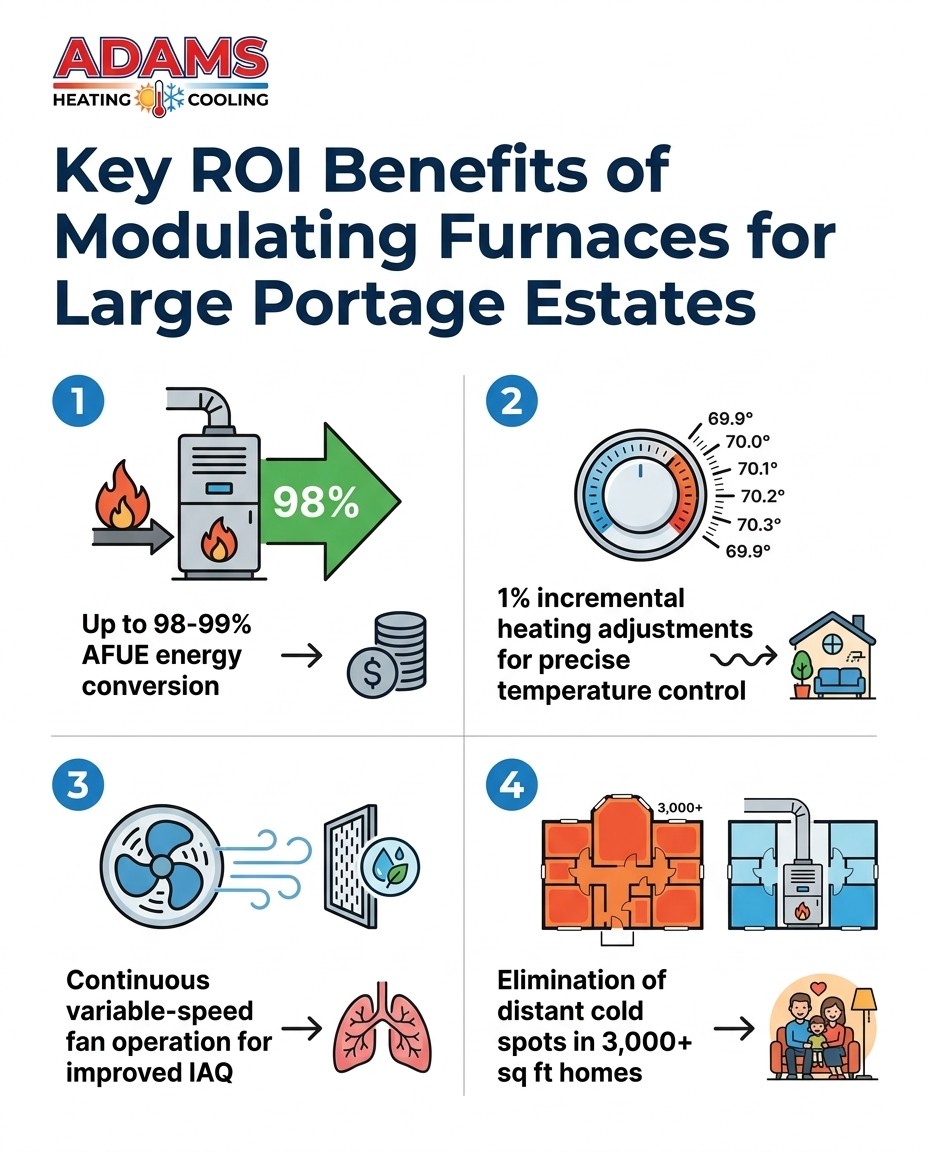
When evaluating a major home upgrade, understanding the technical efficiency of the equipment is essential. For heating systems, this is measured by the Annual Fuel Utilization Efficiency (AFUE) rating. A fully modulating gas furnace represents the pinnacle of this technology, capable of achieving AFUE ratings of up to 98% or 99%. This means that nearly every single unit of fuel consumed by the system is converted directly into usable heat for your home, with virtually zero waste exhausted out of the flue pipe.
The secret behind this extreme efficiency lies in the modulating gas valve. Unlike older systems that operate at 100% capacity whenever they are turned on, a modulating furnace can adjust its heating output in precise 1% increments. If your home only needs a gentle stream of warmth to maintain the current temperature, the furnace might operate at just 40% capacity. This intelligent, real-time adjustment ensures that the system is never using more fuel than absolutely necessary. For homeowners researching the differences between single-stage and two-stage furnaces, the leap to a fully modulating unit offers an entirely different tier of energy management.
How Incremental Heating Reduces Energy Waste
It might seem counterintuitive, but a furnace that runs almost continuously actually uses significantly less energy than one that turns on and off all day. By operating at a lower capacity for longer periods, a modulating furnace avoids the massive fuel spikes required to ignite and warm up a cold heat exchanger. This steady, low-and-slow approach to heating ensures that your energy usage remains flat and predictable, which is a major factor in calculating the long-term return on your investment.
• Single-Stage — Operating Capacity: Always 100% On or Off — Energy Efficiency (AFUE): Typically 80% to 90% — Impact on Home Comfort: Noticeable temperature swings; frequent cold spots in large homes.
• Two-Stage — Operating Capacity: High (100%) or Low (approx. 65%) — Energy Efficiency (AFUE): Typically 90% to 96% — Impact on Home Comfort: Better consistency; fewer temperature swings, but still limited flexibility.
• Fully Modulating — Operating Capacity: Adjusts seamlessly from roughly 35% to 100% in 1% increments — Energy Efficiency (AFUE): Up to 98% or 99% — Impact on Home Comfort: Ultra-precise temperature control; eliminates cold spots entirely.
By converting nearly all of its fuel into usable heat and matching the exact real-time demand of your home, a modulating gas valve essentially pays dividends in energy conservation over the lifespan of the equipment.
Conquering Cold Spots in Distant Rooms and Upper Levels
The financial return on investment is only one part of the equation; the comfort return on investment is equally, if not more, important for homeowners with sprawling floor plans. In large estates, the hidden costs of uneven heating often go unnoticed. When distant bedrooms or isolated wings of the house fail to reach a comfortable temperature, homeowners frequently resort to plugging in inefficient electric space heaters. These supplemental devices draw massive amounts of electricity, quietly undermining the efficiency of the primary heating system and creating potential safety hazards.
Southwest Michigan's harsh, prolonged winters make continuous, low-capacity heating essential to prevent severe cold spots in large estates. When the temperature drops below freezing and stays there for weeks, a standard furnace simply cannot push warm air far enough to keep perimeter rooms comfortable. A modulating furnace solves this by pairing the precise gas valve with a variable-speed blower motor. This motor runs almost continuously at a very low, whisper-quiet speed, constantly circulating warm air to the furthest reaches of the ductwork. The result is an indoor environment where the temperature in a distant upstairs bedroom matches the thermostat in the main hallway within a fraction of a degree.
Why Upstairs Bedrooms Are Always the Hardest to Heat
Upper levels present a unique challenge in large homes. Heat naturally rises, but without proper circulation, that heat gets trapped in stairwells or vaulted ceilings rather than entering the bedrooms. Furthermore, long duct runs leading to the second floor lose air pressure along the way. In a pattern we see often during our fall-prep assessments, a recent Portage homeowner called us to address these exact severe comfort issues. When our Adams Heating & Cooling installation team upgraded their system to a modulating unit, they immediately noticed a transformation in how evenly the air was distributed throughout the upper levels.
The continuous operation of a variable-speed blower provides several comfort advantages:
• Eliminates stagnant air: Constant movement prevents cold air from settling near the floor.
• Whisper-quiet operation: The motor runs at such a low speed that you rarely hear it running, unlike the loud "whoosh" of a single-stage system.
• Consistent warmth: The home feels naturally warm, rather than alternating between drafty and stuffy.
This non-financial ROI—the ability to actually use and enjoy every room in a large house comfortably during a Michigan winter—is often the most celebrated benefit of upgrading to premium technology.
Indoor Air Quality and System Longevity Benefits
When evaluating the true value of a premium heating system, it is crucial to look beyond just temperature control. The continuous operation that makes modulating furnaces so efficient at heating also provides massive secondary benefits for your home's indoor air quality (IAQ) and the physical lifespan of the equipment itself. Because the variable-speed blower motor runs almost constantly at a low speed, the air inside your home is continuously circulating through the return ducts and passing through your HVAC filtration system.
With a standard furnace, the air is only being filtered during the brief periods when the system is actively heating. Once the thermostat is satisfied, the fan shuts off, and airborne particles like dust, pet dander, and pollen are left to settle on your furniture and floors. A modulating system acts as a whole-home air purifier simply by keeping the air moving. Of course, protecting this sophisticated equipment requires ongoing professional care. Enrolling in a preventative maintenance plan ensures that the advanced sensors and variable-speed components remain calibrated for peak performance year after year.
How Less Starting and Stopping Protects Your Investment
The mechanical stress placed on an HVAC system occurs primarily during the startup phase. Every time a standard furnace kicks on, the motors require a surge of electricity, and the heat exchanger experiences rapid thermal expansion. Over years of operation, this constant starting and stopping leads to metal fatigue and component failure.
Here is how a modulating system extends its own lifespan:
1. Reduced Thermal Shock: Because the heat exchanger maintains a steady, low-level temperature rather than rapidly heating and cooling, the metal expands and contracts far less, reducing the risk of stress cracks.
2. Lower Motor Strain: The variable-speed blower ramps up gently rather than jolting to 100% speed, preserving the bearings and electrical components.
3. Fewer Ignition Cycles: The ignitor and gas valve operate less frequently, minimizing the wear and tear on these critical starting components.
4. Enhanced Filtration: By catching more dust and debris in the filter, less particulate matter builds up on the internal blower wheel, keeping the system clean and balanced.
This reduction in mechanical stress directly translates to a potentially longer lifespan for the equipment, adding another layer of long-term value to the initial investment.
The Critical Role of Expert Load Calculations
Purchasing the most advanced, highest-efficiency furnace on the market is only half the battle. The most critical factor in unlocking the true ROI of a modulating furnace is ensuring that the equipment is perfectly sized for your specific home. If a premium unit is installed without a proper, scientific load calculation, its efficiency will be completely ruined. An oversized modulating furnace will still short-cycle, completely negating the benefits of the advanced gas valve and variable-speed blower.
Many homeowners mistakenly believe that "bigger is better" when it comes to heating a 3,000+ square foot estate. In reality, an oversized system will blast too much heat too quickly, satisfying the thermostat before the air has a chance to circulate to distant rooms. This is why a wealth of information and professional guidance is absolutely necessary to select the exact right system for a unique home layout. At Adams Heating & Cooling, our technicians always perform expert load calculations to ensure modulating furnaces are perfectly sized for large square-footage homes, taking into account everything from the quality of your insulation to the number of windows and the specific layout of your ductwork.
Why Guessing on Furnace Size Ruins Efficiency
A professional load calculation, often referred to as a Manual J calculation, is the only way to determine the exact heating demand of a property. Guessing based on square footage alone is a recipe for disaster, especially in large estates with varying ceiling heights and complex architectural features. Recently, when our team designed a new furnace and ductwork system for a client's upstairs bedrooms, we took the time to properly assess the load requirements. As a result, we were able to install a new, quiet furnace and efficiently route the ductwork, creating a perfectly balanced upper level.
A proper load calculation evaluates:
• Square footage and volume: Factoring in vaulted ceilings and open floor plans.
• Thermal envelope: Assessing the R-value of insulation in the attic, walls, and basement.
• Window efficiency: Accounting for heat loss through single-pane or double-pane glass, as well as the directional orientation of the windows.
• Ductwork condition: Ensuring the existing ducts can handle the airflow requirements of a variable-speed system.
True ROI is a combination of premium equipment and expert installation. Without precise sizing, even a 99% AFUE furnace will fail to deliver the comfort and savings you expect.
Timing Your Upgrade and Managing the Investment
The decision of when to upgrade is just as important as choosing the right equipment. Waiting until your current system suffers a catastrophic breakdown in the dead of winter puts you at a severe disadvantage. Emergency replacements often limit your options, forcing you to settle for whatever equipment is immediately available in the warehouse rather than custom-ordering the perfect modulating unit for your home. Based on our extensive experience preparing Kalamazoo area homes for winter, we highly recommend upgrading during the September pre-heating season as the most strategic move a homeowner can make.
Waiting too long can lead to stressful emergencies. In one instance, a local homeowner discovered a crack in their heat exchanger during heavy snow. Fortunately, our team was able to install a new furnace within a week, but proactive replacement prevents this kind of mid-winter panic altogether. Furthermore, high-efficiency furnaces often qualify for generic utility rebates or federal tax credits. While these programs change frequently, upgrading to a 98% or 99% AFUE system typically positions you to take advantage of the highest available incentives. We strongly advise readers to verify current programs with their local utility providers or a tax professional to maximize their return.
Navigating Rebates and Tax Incentives
Managing the initial investment of a premium heating system is easier than ever, thanks to a combination of energy incentives and structured payment plans. Spreading the initial investment over time makes premium comfort highly accessible, allowing the monthly energy savings to help offset the cost of the equipment.
Strategic advantages of a pre-season upgrade include:
• Time to research: You have the luxury of reviewing load calculations and comparing modulating options without the pressure of a freezing house.
• Rebate eligibility: High-AFUE systems frequently meet the strict criteria for local and federal energy efficiency incentives.
• Flexible scheduling: Installation teams have more availability in early fall, ensuring your project is completed exactly when you want it.
Adams Heating & Cooling offers flexible furnace financing options to help offset the initial investment. By taking action before the snow flies, you ensure that your large estate is equipped with the most efficient, comfortable, and reliable heating technology available, providing a clear and lasting return on your investment.
Frequently Asked Questions
Is a modulating furnace worth the investment for a large home?
Yes, a modulating furnace is highly recommended for large homes due to its ability to provide consistent, even heating across expansive square footage. By adjusting its output in tiny increments, it prevents the temperature swings and cold spots common in 3,000+ square foot estates. The long-term energy savings from its high AFUE rating, combined with the significant increase in daily comfort, make it a strong investment for sprawling properties.
How does a modulating furnace eliminate cold spots?
A modulating furnace eliminates cold spots by running almost continuously at a very low capacity, paired with a variable-speed blower motor. This constant circulation pushes warm air deep into the furthest reaches of your ductwork, ensuring distant bedrooms receive the same amount of heat as the central living areas. Because the air never stops moving, it prevents cold air from settling and creating stagnant, chilly zones.
What makes modulating furnaces more efficient than single-stage units?
Modulating furnaces are more efficient because they can adjust their gas valve in 1% increments to match the exact heating demand of the home, whereas single-stage units can only operate at 100% capacity. This precision allows modulating systems to achieve up to 99% AFUE, meaning almost no fuel is wasted during the combustion process. By avoiding the massive energy spikes required to constantly start and stop, they consume significantly less fuel overall.
What is the life expectancy of a modulating furnace?
When properly sized and maintained, a modulating furnace can typically last 15 to 20 years or more. The continuous, low-capacity operation actually reduces mechanical wear and tear, as the system experiences fewer hard starts and less thermal stress on the heat exchanger. Regular professional maintenance is essential to keep the advanced sensors and variable-speed components functioning optimally over its lifespan.
Do high-efficiency furnaces qualify for tax credits?
Yes, high-efficiency modulating furnaces frequently qualify for various generic utility rebates and federal energy tax credits due to their exceptional AFUE ratings. Because these systems significantly reduce energy consumption, many local programs incentivize their installation. Homeowners should always verify current programs and eligibility requirements with their utility provider or a qualified tax professional before purchasing.
How long does a modulating furnace run during a typical Michigan winter day?
During a cold Michigan winter day, a modulating furnace is designed to run almost continuously, often operating for hours at a time at a very low capacity. This is entirely normal and is exactly how the system achieves its high efficiency and supreme comfort levels. Rather than blasting heat and shutting off, it provides a steady, quiet stream of warmth that perfectly matches the heat loss of your home.
Customer Testimonials

In the past 18 months, Adams has installed a new Amana air conditioning system, and new filtration and humidification systems at my home. The installers were all very courteous, professional and knowledgeable. Their work was simply superb... reasonably priced, and performed on time and to perfection! I enthusiastically recommend Adams, without reservation!
As usual, Adams Heating and Cooling exceeded our expectations. The quote was done in a timely manner, pricing was fair, installation was quick and the job was done right! Rob is great to work with. Adams is first on our list!
Called these guys off of a referral from a friend. Home furnace failure in sub-zero temperatures, late at night. Dan was there in an hour. Friendly, polite, professional and most importantly, very competent. Diagnosed and fixed the problem in under an hour. After hours 24/7 pricing was surprisingly reasonable. This outfit gets straight A+ from us.
Excellent service! We had them replace our heater, AC, and water heater as a package deal. They even helped with financing as it was a large expense to address at one time. It left us with peace of mind that all the mechanicals in our home were new!
They have always been there for us and did so again by responding quickly to put in a new furnace after a lighting strike caused a power surge. In addition, their electrician came by to help with other issues caused by the strike. Everyone we work with from the who answers the phone to who shows up to complete the work are polite, pleasant and professional! And quick to respond and on time!
From the service call to the installation with Dan, Dave, and Daniel… our experience was top notch. They quickly came out, identified the problem, and installation of our new unit took less than 3 hours. Can’t recommend Adams enough!
Dan, Dave and Mike were phenomenal! Very patient, listened to my questions/concerns, and made sure that everything was working and that my Nest was working correctly, before leaving. Thank you so much for your service!
Service was excellent! Had a new furnace installed. The technicians did a wonderful job and completed the installation quickly. Mike answered my questions and followed up to verify the worke done. I was charged just as I was quoted. Have used Adam's for repairs in the past and I'm always pleased. Great work!
I had a boiler and water heater replacement/upgrade. I went from an 84% efficient boiler to a 95% efficient. I dont recall the water heater's efficiency. That was upgraded to an indirect water heater. Josh and Brad did a great job. The work looks great. The boiler and water heater work as to be expected. Their customer service is excellent. I will definitely be calling then when my basement remodel is ready to start.
I have had Adam's Heating and Cooling out at my house before, so I called them for some gas line work. The estimator was very helpful and let me know the best way to be ready for when the work is scheduled so they can test the generator after they install the gas line to the meter and also let me know how to take care of another issue I had that would be helpful. I look forward to getting this work done and working with them.

Financing
Flexible financing options are available to help you get the comfort you need without the upfront financial stress.