

Why Multi-Level Kalamazoo Homes Struggle with Winter Cold Spots
When evaluating Single-Stage vs. Two-Stage Furnaces: Comfort Tradeoffs for Multi-Level Michigan Homes, are you tired of roasting in your downstairs living room while shivering in your upstairs bedroom? If you live in one of the many multi-level homes in our area, you likely know the frustration of uneven winter heating. You crank up the thermostat to keep the second floor bearable, only to turn the main floor into a sauna. Our team at Adams Heating & Cooling sees this common pattern constantly during our fall maintenance visits. Many homeowners assume their heater just lacks the raw power to warm the whole house. Here is the thing: raw heating capacity is rarely the core issue. The real challenge is air distribution. Deciding whether a system upgrade is necessary to solve this uneven heating requires looking beyond the basic equipment box. When you are ready to explore comprehensive heating services, understanding how different furnace technologies move air through your home is the first critical step.
The Illusion of Raw Heating Power
Most homeowners assume that a colder upstairs simply means they need a bigger furnace. In reality, our technicians find that oversized heating equipment often makes temperature imbalances worse. When a furnace is too large for the space, it blasts a massive amount of heat very quickly, satisfying the main-floor thermostat in a matter of minutes. Once that thermostat clicks off, the heating cycle stops entirely.
The distribution problem: Because the cycle is so brief, the blower motor never gets the chance to push that freshly heated air all the way up the ductwork to the second-story bedrooms. The result is a home where the first floor is sweltering, the upstairs is freezing, and the furnace itself undergoes unnecessary wear and tear from constantly starting and stopping.
Understanding the Stack Effect and Thermal Stratification in Michigan Winters
To truly understand why your upstairs bedrooms feel like iceboxes, our Kalamazoo HVAC experts look at the basic physics of how air moves inside a house. Two natural phenomena work against your comfort: thermal stratification and the stack effect. When you are focused on fixing HVAC temperature fluctuations, you are actually fighting against these invisible forces every single day.
The Physics of Heat Loss in Multi-Level Homes
Thermal stratification is the natural tendency for warm air to rise and cold air to sink. In a two-story home, the warmest air naturally floats toward the ceiling of the second floor. However, if your attic or roofline is poorly insulated, that heat escapes rapidly into the freezing outdoors. Meanwhile, the heavy, cold air pools on the lower levels.
The stack effect acts like a subtle vacuum. As warm air escapes out the top of your house, it creates negative pressure at the bottom, pulling freezing outdoor air in through gaps around doors, windows, and basements.
Michigan's prolonged, harsh sub-freezing temperatures severely exacerbate these natural physical effects compared to milder climates. When the outdoor temperature hovers in the teens or twenties for weeks on end, the rate of heat loss through your roof accelerates drastically. Without continuous air mixing from your heating system, the temperature differential between your first and second floors becomes extreme.
The Shortcomings of Single-Stage Furnaces for Two-Story Heating
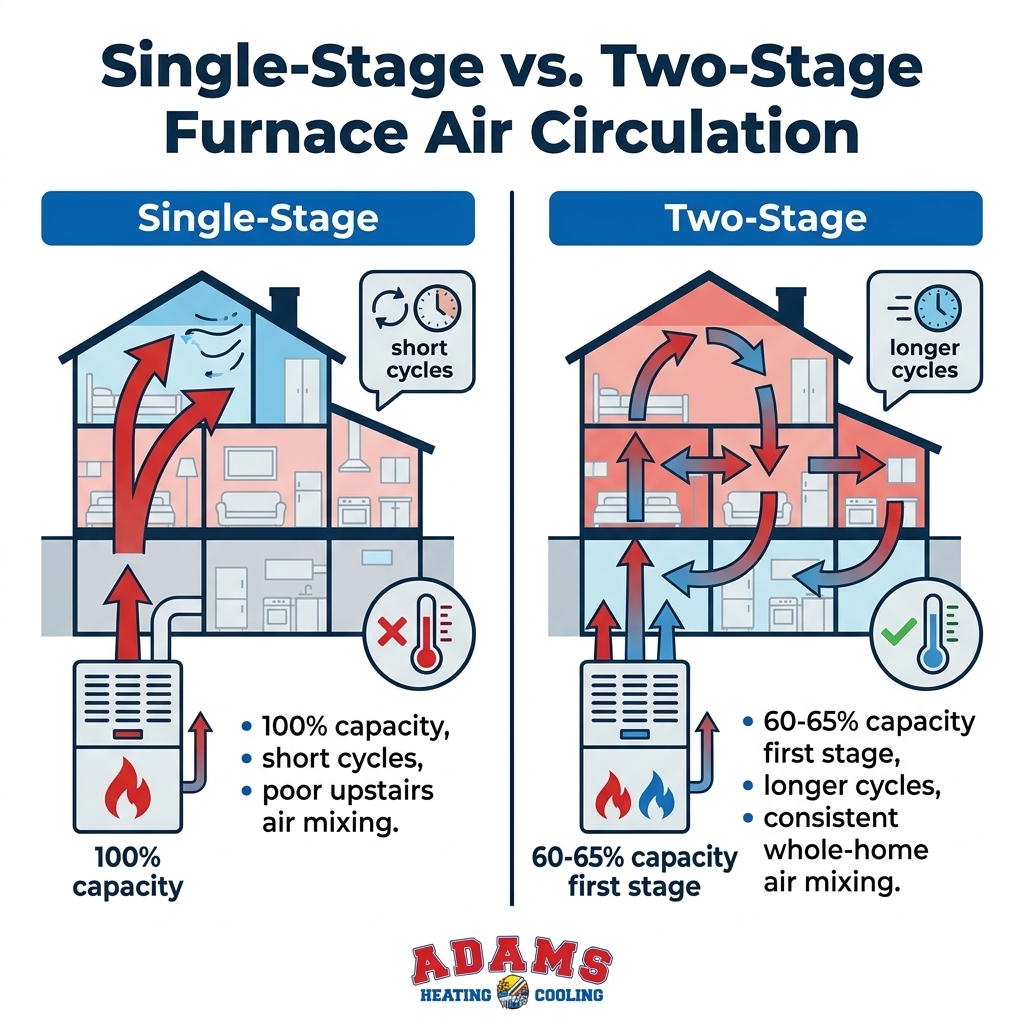
A traditional single-stage furnace operates on a very simple premise: it is either completely on or completely off. There is no middle ground. When the thermostat calls for heat, the gas valve opens to 100% capacity, and the blower motor kicks on at full speed. While our team agrees this brute-force approach works fine for small, single-story houses, it falls significantly short in multi-level structures.
The Short-Cycling Dilemma
During moderately cold days, a single-stage furnace will quickly satisfy the thermostat located on the main floor. This leads to a phenomenon known as "short cycling."
• The quick shutoff: The main floor reaches 70 degrees in just ten minutes, causing the system to shut down.
• Stranded air: Warm air never reaches the end of the duct runs, leaving upstairs bedrooms completely unheated.
• Harsh temperature swings: The house rapidly cools down, prompting another aggressive, noisy blast of heat just a few minutes later.
If your current system is failing to push air upstairs, a modern Daikin furnace installation might be the exact upgrade your home needs. Upgrading to a more advanced system changes the entire dynamic of how air flows through your ductwork, a transformation we love showing our Kalamazoo customers.
How Two-Stage Furnaces Deliver Consistent Upstairs Air Circulation
If a single-stage furnace is like a light switch, a two-stage furnace is like a light switch with a dimmer. These systems have a gas valve that can operate at two distinct levels: a low setting (typically 60% to 65% capacity) and a high setting (100% capacity). This simple mechanical difference completely changes how a multi-level home feels during the winter.
The Power of Continuous Air Mixing
For the vast majority of the winter, a two-stage furnace will operate exclusively in its first, lower stage. Because it is only producing about 60% of its maximum heat, it takes longer to satisfy the main-floor thermostat.
Why longer cycles matter: A longer heating cycle means the blower motor runs continuously for 30 to 45 minutes rather than just 10. This steady, gentle pressure fills the entire duct system, finally forcing warm air up into the second-story bedrooms. By continuously mixing the air throughout the house, the system naturally breaks up thermal stratification and eliminates cold spots.
One local Kalamazoo homeowner recently reached out to Adams Heating & Cooling because they needed a new furnace and ductwork to finally get air to their upstairs bedrooms. After our team provided a comprehensive assessment, a new, exceptionally quiet system and updated ductwork were installed within a week. The outcome was a beautifully efficient setup that finally pushed warm air into those hard-to-reach rooms, proving that the right equipment makes all the difference.
Side-by-Side Comparison: Single-Stage vs. Two-Stage Performance
When weighing your options, it helps to see exactly how these two technologies stack up against each other. At Adams Heating & Cooling, we frequently see homeowners struggling with this exact choice. Last spring, a local customer needed help deciding which furnace was right for their two-story home. By sitting down with them and providing clear information on how these different stages impact airflow, we guided the customer to choose the correct system for their specific layout.
Here is a direct comparison of the comfort tradeoffs for multi-level homes:
• Heating Capacity — Single-Stage Furnace: Always 100% (On or Off) — Two-Stage Furnace: 60-65% (Low) or 100% (High)
• Cycle Length — Single-Stage Furnace: Short, aggressive blasts — Two-Stage Furnace: Long, gentle, continuous runs
• Upstairs Air Circulation — Single-Stage Furnace: Poor; shuts off before air reaches bedrooms — Two-Stage Furnace: Excellent; continuous pressure fills ductwork
• Temperature Swings — Single-Stage Furnace: Noticeable hot and cold spikes — Two-Stage Furnace: Consistent, even temperatures floor-to-floor
• Operating Noise — Single-Stage Furnace: Loud startup and high airflow noise — Two-Stage Furnace: Very quiet during primary low-stage operation
Why Early Fall is the Ideal Time to Upgrade Your Heating System
Timing is everything when it comes to major home improvements. As we tell our customers, early fall pre-heating season prep is the absolute best window to evaluate your home's comfort needs. Waiting until the first major freeze hits puts you at a severe disadvantage.
The Risks of Waiting for a Winter Breakdown
When a furnace fails in the middle of January, homeowners are often forced into panic buying. In an emergency situation, the primary goal is simply getting the heat back on as fast as possible. This rushed environment leaves very little time to thoughtfully evaluate whether a single-stage or two-stage system is best for your home's unique layout.
By assessing your system in September or October, you gain the luxury of choice. You can test your current setup, map out the cold spots in your upstairs bedrooms, and make an informed decision without shivering in your living room. Proactive replacement allows for careful system staging and sizing. If your current system is still relatively young but struggling, booking routine furnace maintenance now ensures it operates as safely and efficiently as possible until a planned replacement can occur.
Guaranteed Whole-Home Comfort Beyond Generic Equipment Swaps
The short answer is that simply buying a two-stage furnace is not a magic cure-all. In our professional experience, if a contractor just drops a new, expensive box into your basement without evaluating the rest of your home, you will likely still have cold bedrooms.
Why Proper System Matching Matters
Solving multi-level heating issues requires a holistic approach. The new furnace must be perfectly sized for your home's square footage, and its blower motor must be calibrated to match the capacity of your existing ductwork. If your ducts are undersized, crushed, or leaking, even the best two-stage furnace will struggle to push air upstairs.
This is where standard equipment swaps fail and comprehensive guarantees succeed. By enrolling in the Peace of Mind Program, you are protected against generic, poorly planned installations. This comprehensive approach ensures that your system is properly matched, calibrated, and guaranteed to deliver the actual whole-home comfort outcome you expect, rather than just leaving you with a shiny new box that repeats the same old problems.
Frequently Asked Questions About Furnace Upgrades for Multi-Level Homes
Is a 2-stage furnace worth the extra money?
Yes, for multi-level homes, the return on investment is highly noticeable in daily comfort. The longer run times continuously mix the air, significantly reducing cold spots in upstairs bedrooms. Over time, the lower-stage operation also provides better energy efficiency, as the system isn't constantly burning maximum fuel to overcome short cycles. Additionally, qualifying high-efficiency installations may be eligible for energy rebates or tax credits—we advise verifying current programs with your utility provider or a tax professional.
Does a two-stage furnace heat a two-story house better?
Absolutely. By running longer at a lower capacity (usually around 60%), a two-stage furnace keeps the blower motor pushing air for extended periods. This steady, continuous pressure forces warm air all the way up the ductwork to the second floor, rather than shutting off as soon as the main floor gets warm.
Will a two-stage furnace fix cold spots upstairs?
It significantly reduces them by providing continuous air circulation that breaks up thermal stratification. However, our technicians always emphasize that the furnace is only half of the equation. Proper ductwork sizing and integrity are also essential; if your ducts are crushed or disconnected, even a two-stage furnace cannot push air through them effectively.
What are the downsides of a two-stage furnace?
The primary downside is a higher initial installation cost compared to basic single-stage models. Additionally, two-stage systems feature slightly more complex internal components, such as multi-stage gas valves and advanced control boards, which require knowledgeable technicians for accurate setup and future maintenance.
Can I upgrade to a two-stage furnace using my existing ductwork?
Usually, yes, but a professional assessment is highly recommended before installation. Because two-stage furnaces rely on longer, lower-speed airflow cycles, your existing ducts must be able to handle these altered dynamics without significant pressure drops or air leaks.
Secure Your Upstairs Comfort Before the Freezing Temperatures Arrive
Most homeowners don't realize that they don't have to settle for freezing upstairs bedrooms every winter. A two-stage furnace is a powerful, proven solution for eliminating cold spots through longer, gentler heating cycles that push air exactly where it needs to go. Taking action during early fall pre-heating season prep gives you the time to make a thoughtful, unhurried decision. Schedule a thorough assessment of your multi-level home with Adams Heating & Cooling today, and discover exactly which system will finally bring consistent comfort to every room in your house.
Customer Testimonials

In the past 18 months, Adams has installed a new Amana air conditioning system, and new filtration and humidification systems at my home. The installers were all very courteous, professional and knowledgeable. Their work was simply superb... reasonably priced, and performed on time and to perfection! I enthusiastically recommend Adams, without reservation!
As usual, Adams Heating and Cooling exceeded our expectations. The quote was done in a timely manner, pricing was fair, installation was quick and the job was done right! Rob is great to work with. Adams is first on our list!
Called these guys off of a referral from a friend. Home furnace failure in sub-zero temperatures, late at night. Dan was there in an hour. Friendly, polite, professional and most importantly, very competent. Diagnosed and fixed the problem in under an hour. After hours 24/7 pricing was surprisingly reasonable. This outfit gets straight A+ from us.
Excellent service! We had them replace our heater, AC, and water heater as a package deal. They even helped with financing as it was a large expense to address at one time. It left us with peace of mind that all the mechanicals in our home were new!
They have always been there for us and did so again by responding quickly to put in a new furnace after a lighting strike caused a power surge. In addition, their electrician came by to help with other issues caused by the strike. Everyone we work with from the who answers the phone to who shows up to complete the work are polite, pleasant and professional! And quick to respond and on time!
From the service call to the installation with Dan, Dave, and Daniel… our experience was top notch. They quickly came out, identified the problem, and installation of our new unit took less than 3 hours. Can’t recommend Adams enough!
Dan, Dave and Mike were phenomenal! Very patient, listened to my questions/concerns, and made sure that everything was working and that my Nest was working correctly, before leaving. Thank you so much for your service!
Service was excellent! Had a new furnace installed. The technicians did a wonderful job and completed the installation quickly. Mike answered my questions and followed up to verify the worke done. I was charged just as I was quoted. Have used Adam's for repairs in the past and I'm always pleased. Great work!
I had a boiler and water heater replacement/upgrade. I went from an 84% efficient boiler to a 95% efficient. I dont recall the water heater's efficiency. That was upgraded to an indirect water heater. Josh and Brad did a great job. The work looks great. The boiler and water heater work as to be expected. Their customer service is excellent. I will definitely be calling then when my basement remodel is ready to start.
I have had Adam's Heating and Cooling out at my house before, so I called them for some gas line work. The estimator was very helpful and let me know the best way to be ready for when the work is scheduled so they can test the generator after they install the gas line to the meter and also let me know how to take care of another issue I had that would be helpful. I look forward to getting this work done and working with them.

Financing
Flexible financing options are available to help you get the comfort you need without the upfront financial stress.