

The Hidden Cause of Slamming Doors in Portage Restaurants
If you operate a commercial kitchen, understanding why Portage restaurants need specialized make-up air assessments before winter is the key to solving one of the most frustrating early fall problems: front doors that suddenly become incredibly heavy to open and slam violently shut behind your patrons. Your first instinct might be to blame the changing weather, a misaligned door hinge, or a worn-out hydraulic closer. However, our team at Adams Heating & Cooling can tell you that intense physical resistance is rarely a hardware issue. It is a glaring symptom of a severe negative pressure imbalance inside your building, driven by the massive volume of air being removed by your commercial kitchen exhaust hoods.
To restore balanced airflow and protect your dining environment, explore our commercial HVAC solutions and comprehensive commercial heating services today.
In our experience serving Portage commercial dining spaces, we frequently hear from facility managers who notice these drafts and door issues as soon as the outdoor temperatures begin to drop in September. When a commercial kitchen operates high-capacity exhaust hoods without an equally powerful system to bring fresh air back inside, the entire building acts like a giant vacuum. This vacuum effect pulls unconditioned outside air through every available crack, crevice, and entryway. Ignoring this pressure differential during the mild weeks of early fall guarantees a miserable environment for both your staff and your customers once the deep freeze of winter sets in. Professional intervention is required to calibrate your airflow before the heating season officially begins.
Understanding Negative Pressure in Commercial Kitchens
To grasp why your building is fighting against itself, you have to look at the sheer volume of air moving through a commercial cooking space. The physics of ventilation rely on a delicate balance between the air leaving the building and the air entering it. When that balance is broken, the results we see in the field are immediate and highly disruptive to daily operations.
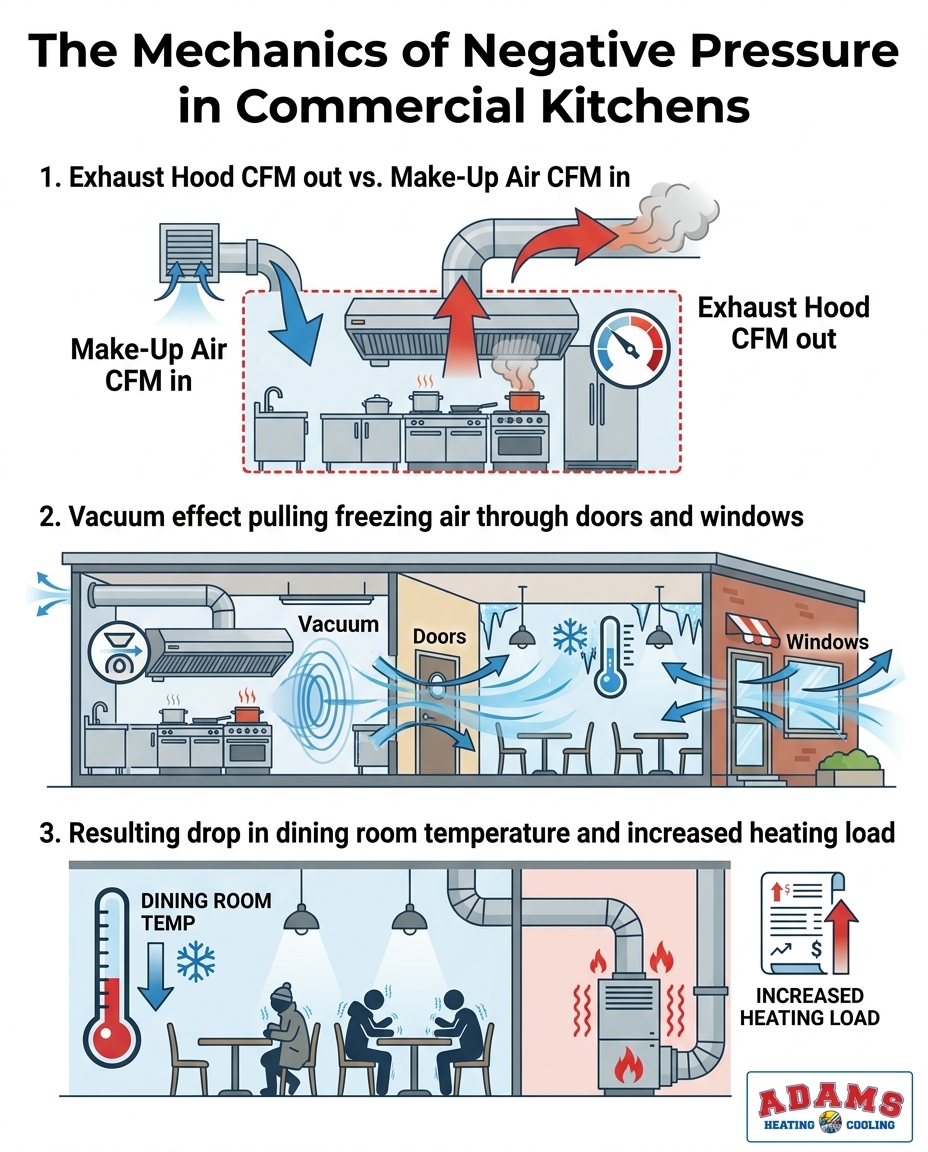
Negative pressure occurs when your facility exhausts more air than it replaces. In a restaurant, the primary culprits are the massive exhaust hoods positioned over your ranges, fryers, and grills. These systems are designed to aggressively pull smoke, grease-laden vapors, and excessive heat out of the kitchen to maintain a safe working environment. However, every single cubic foot of air that leaves through the exhaust duct must be replaced by fresh make-up air from the outside. If your make-up air unit is broken, undersized, or improperly calibrated, the building depressurizes. The resulting vacuum forcefully draws outside air indoors, rapidly degrading your indoor air quality by pulling in untreated, unfiltered air from loading docks, alleyways, and front entrances.
The Role of Exhaust Hood CFM Ratings
The severity of this vacuum effect comes down to basic mathematics. Commercial exhaust fans are rated by Cubic Feet per Minute (CFM). A standard commercial kitchen hood might pull anywhere from 2,000 to 8,000 CFM depending on the cooking volume. If your exhaust system is pulling 5,000 CFM out of the building, your make-up air system must deliver exactly 5,000 CFM back into the building to maintain equilibrium. When the make-up air falls short, the building uses its own exterior walls, doors, and windows as the intake vents, leading to the severe drafts and slamming doors that frustrate your patrons.
How Harsh Michigan Winters Magnify Ventilation Imbalances
A negative pressure issue exists year-round, but it only becomes a full-blown operational crisis when the seasons change. In the middle of summer, pulling 85-degree air into an air-conditioned dining room is certainly inefficient, but it is often masked by powerful cooling systems. However, Portage and Kalamazoo's harsh, freezing winter temperatures and high wind chills instantly ruin patron comfort when negative pressure pulls that outside air indoors.
The thermal impact of freezing air infiltration is staggering. When the temperature outside drops to 15 degrees, every time a customer opens the front door, the building's vacuum effect sucks a massive volume of freezing air directly into the dining room. This continuous infiltration prevents the space from ever reaching a comfortable, stable temperature, no matter how high you set the thermostat. Your heating equipment is forced to run continuously, battling an endless stream of freezing air that it was never designed to condition all at once. If you are constantly fixing unexpected temperature fluctuations in your dining area, our team will likely identify negative pressure as the root cause.
• Summer (85°F+) — Impact of Negative Pressure: Humid, warm air infiltrates the dining room, causing muggy conditions. — Effect on HVAC Equipment: AC runs longer cycles, struggling to dehumidify the constant influx of outside air.
• Early Fall (50°F - 60°F) — Impact of Negative Pressure: Mild cool drafts begin to appear; doors start feeling slightly heavier. — Effect on HVAC Equipment: Heating system begins short-cycling as mild cool air disrupts thermostat readings.
• Deep Winter (Below 32°F) — Impact of Negative Pressure: Violent, freezing drafts sweep the floor; doors slam shut violently. — Effect on HVAC Equipment: Furnaces and boilers run continuously, risking premature failure from extreme thermal loads.
Recognizing the Symptoms in Portage Commercial Dining Spaces
Technical HVAC concepts like CFM and pressure differentials can seem abstract, but the physical symptoms of a ventilation imbalance are highly observable. In our years of servicing local facilities, restaurant owners and facility managers in Portage commercial dining spaces experience these tangible warning signs daily once the weather begins to cool down.
• Violently slamming front doors: The most obvious physical symptom of negative pressure. The vacuum effect pulls inward so strongly that exterior doors become incredibly difficult to pull open from the outside, and they slam shut with dangerous force behind exiting patrons.
• Localized cold drafts sweeping the floor: Because cold air is dense, the freezing air pulled through door seals and window frames sinks immediately to the floor. This creates a persistent freezing draft around the ankles of your guests, driving customers away from window or door seating.
• Lingering cooking odors in the dining room: In a properly balanced restaurant, air should flow gently from the dining room toward the kitchen. Negative pressure disrupts this directional airflow, allowing grease, smoke, and strong cooking odors to drift out into the seating area.
• Hazardous backdrafting of combustion appliances: If the pressure imbalance is severe enough, the vacuum effect can overpower the flues of gas-fired water heaters and furnaces. Instead of venting safely outside, dangerous exhaust gases—including carbon monoxide—can be pulled back into the building.
Navigating Michigan Mechanical Code and ASHRAE Standards
Balancing commercial kitchen ventilation is not just a matter of improving customer comfort; it is a strict regulatory requirement. The guidelines governing commercial cooking operations and ventilation are highly specific, and failing to meet them can result in failed health and safety inspections, or worse, hazardous indoor conditions for your staff.
ASHRAE Standard 154 provides the definitive engineering guidelines for commercial cooking operations, detailing exactly how exhaust and make-up air must interact. Furthermore, the Michigan Mechanical Code (Chapter 5) strictly mandates specific exhaust and make-up air balances for all commercial kitchens. These codes require that make-up air be mechanically introduced to replace the exhausted air, ensuring that the building's pressure remains neutral or only slightly negative. Compliance with these codes is critical for preventing the dangerous backdrafting of combustion appliances mentioned earlier.
Diagnosing these code-specific requirements requires specialized local expertise. Our team at Adams Heating & Cooling brings deep local expertise in Southwest Michigan commercial building requirements, offering the unique capability to diagnose complex code-compliant ventilation imbalances. Ensuring your facility meets these stringent mechanical codes protects your business from liability while simultaneously resolving the airflow issues that drive customers away during the winter months.
Inside a Professional Make-Up Air Assessment
Understanding the diagnostic process helps demystify how our commercial HVAC professionals identify and correct these invisible airflow problems. A professional assessment goes far beyond simply checking if a fan motor is spinning; it involves precise mathematical measurements and thorough mechanical inspections.
1. Measuring Actual Exhaust and Make-Up Air CFM: Our technicians begin by using specialized anemometers and airflow hoods to measure exactly how much air your kitchen exhaust hoods are pulling out, and exactly how much air your make-up air unit is pushing back in. This reveals the exact mathematical deficit causing the vacuum effect.
2. Testing Building Pressure Differentials: Using a digital manometer, we test the pressure difference between the kitchen, the dining room, and the outdoors. This confirms the severity of the negative pressure and identifies exactly where the building is drawing in unconditioned air.
3. Inspecting Existing Make-Up Air Units and Ductwork: The physical equipment is thoroughly evaluated. We check the make-up air unit's blower motor, belts, filters, and heating elements (if the incoming air is tempered). We also inspect the ductwork for blockages or leaks that might be restricting airflow.
4. Evaluating Motorized Dampers and Controls: Many modern systems use interlocked controls where the make-up air unit automatically turns on when the exhaust hood is activated. Our assessment verifies that these sensors, relays, and motorized dampers are communicating correctly.
Scheduling this type of comprehensive evaluation as part of a regular preventative maintenance plan prevents sudden system failures during your peak operational hours. Additionally, if your assessment reveals that equipment upgrades are necessary, local utility incentive programs or tax credits may apply to qualifying high-efficiency installations. We always advise readers to verify current programs with their utility provider or a tax professional.
Why the September Pre-Heating Season Transition is Critical
Timing is everything when it comes to commercial HVAC maintenance. The September pre-heating season transition is the absolute most critical window for correcting negative pressure issues. During early fall, the weather in Michigan is often mild enough that a broken make-up air unit doesn't immediately cause a crisis. The drafts are noticeable but tolerable, and the heating system isn't running at full capacity yet.
However, we consistently warn our commercial clients that this mild weather masks the true severity of the negative pressure that will become unbearable by December. Those early fall drafts are the first warning signs of a compromised commercial heating setup. If you wait until the first major snowstorm to address slamming doors and a freezing dining room, you risk emergency service call delays, overworked heating equipment, and lost revenue from patrons who refuse to sit in a cold restaurant during the busy holiday season.
Proactive calibration is the only way to secure your building's thermal envelope. Facility managers must act to secure their heating performance before the first hard freeze hits the region. By measuring and correcting the CFM balance now, you ensure that your heating system will perform efficiently and your dining room will remain comfortable, no matter how harsh the winter becomes.
Frequently Asked Questions About Restaurant Ventilation
Why does my commercial kitchen need make-up air?
Your commercial kitchen needs make-up air to replace the massive volume of air removed by exhaust hoods, preventing negative pressure and ensuring the safe operation of gas appliances. Without it, the building acts like a vacuum, pulling in unconditioned outside air through every gap and doorway. This imbalance ruins temperature control and forces your HVAC system to work exponentially harder.
What causes slamming doors in restaurants?
Severe negative pressure creates a vacuum effect that pulls violently on exterior doors, making them hard to open and causing them to slam shut. When the kitchen exhaust fans pull thousands of cubic feet of air out of the building without replacing it, the resulting pressure differential uses the front doors as an intake valve. Correcting the make-up air balance immediately resolves this physical resistance.
How does negative pressure affect restaurant heating?
Negative pressure forces unconditioned, freezing outside air into the building, overwhelming the heating system and creating persistent cold drafts. Because the vacuum effect constantly pulls in cold air from the outside, the dining room can never reach a stable, comfortable temperature. This causes furnaces and boilers to run continuously, driving up utility costs and risking premature equipment failure.
Is makeup air required for a commercial hood?
Yes, the Michigan Mechanical Code and ASHRAE standards legally require balanced make-up air for commercial exhaust systems. These codes mandate that the air exhausted by high-capacity hoods must be mechanically replaced to maintain neutral building pressure. Compliance is essential not only for passing health and safety inspections but also for preventing the hazardous backdrafting of carbon monoxide from other gas appliances.
How long does a professional make-up air assessment take?
Assessments vary by facility size but generally require a few hours of specialized diagnostic testing by a licensed commercial HVAC technician. The process involves measuring the actual CFM of all exhaust and intake vents, testing building pressure differentials, and physically inspecting the make-up air units on the roof. This thorough evaluation provides the exact data needed to recalibrate the building's airflow.
Secure Your Restaurant's Comfort Before Winter Arrives
Slamming doors, freezing floors, and overworked furnaces are preventable HVAC issues, not inevitable winter realities. Understanding why Portage restaurants need specialized make-up air assessments before winter empowers facility managers to act proactively during the fall transition. By scheduling a specialized assessment with our local experts today, you can correct invisible pressure imbalances, ensure code compliance, and guarantee a warm, welcoming dining environment for your patrons all winter long.
Customer Testimonials

In the past 18 months, Adams has installed a new Amana air conditioning system, and new filtration and humidification systems at my home. The installers were all very courteous, professional and knowledgeable. Their work was simply superb... reasonably priced, and performed on time and to perfection! I enthusiastically recommend Adams, without reservation!
As usual, Adams Heating and Cooling exceeded our expectations. The quote was done in a timely manner, pricing was fair, installation was quick and the job was done right! Rob is great to work with. Adams is first on our list!
Called these guys off of a referral from a friend. Home furnace failure in sub-zero temperatures, late at night. Dan was there in an hour. Friendly, polite, professional and most importantly, very competent. Diagnosed and fixed the problem in under an hour. After hours 24/7 pricing was surprisingly reasonable. This outfit gets straight A+ from us.
Excellent service! We had them replace our heater, AC, and water heater as a package deal. They even helped with financing as it was a large expense to address at one time. It left us with peace of mind that all the mechanicals in our home were new!
They have always been there for us and did so again by responding quickly to put in a new furnace after a lighting strike caused a power surge. In addition, their electrician came by to help with other issues caused by the strike. Everyone we work with from the who answers the phone to who shows up to complete the work are polite, pleasant and professional! And quick to respond and on time!
From the service call to the installation with Dan, Dave, and Daniel… our experience was top notch. They quickly came out, identified the problem, and installation of our new unit took less than 3 hours. Can’t recommend Adams enough!
Dan, Dave and Mike were phenomenal! Very patient, listened to my questions/concerns, and made sure that everything was working and that my Nest was working correctly, before leaving. Thank you so much for your service!
Service was excellent! Had a new furnace installed. The technicians did a wonderful job and completed the installation quickly. Mike answered my questions and followed up to verify the worke done. I was charged just as I was quoted. Have used Adam's for repairs in the past and I'm always pleased. Great work!
I had a boiler and water heater replacement/upgrade. I went from an 84% efficient boiler to a 95% efficient. I dont recall the water heater's efficiency. That was upgraded to an indirect water heater. Josh and Brad did a great job. The work looks great. The boiler and water heater work as to be expected. Their customer service is excellent. I will definitely be calling then when my basement remodel is ready to start.
I have had Adam's Heating and Cooling out at my house before, so I called them for some gas line work. The estimator was very helpful and let me know the best way to be ready for when the work is scheduled so they can test the generator after they install the gas line to the meter and also let me know how to take care of another issue I had that would be helpful. I look forward to getting this work done and working with them.

Financing
Flexible financing options are available to help you get the comfort you need without the upfront financial stress.