

Preparing Your Outdoor Unit: The Costly DIY Mistake to Avoid This Fall
September fall-prep is officially here, and before the first freeze hits Kalamazoo, you need to know about winterizing your AC condenser: what actually works vs. damaging DIY wraps. As the crisp autumn weather arrives and leaves begin to drop, it is entirely natural to want to protect your expensive outdoor cooling equipment from the harsh elements that are just around the corner. Unfortunately, one of the most common methods homeowners use to protect their equipment is actually the fastest way to destroy it.
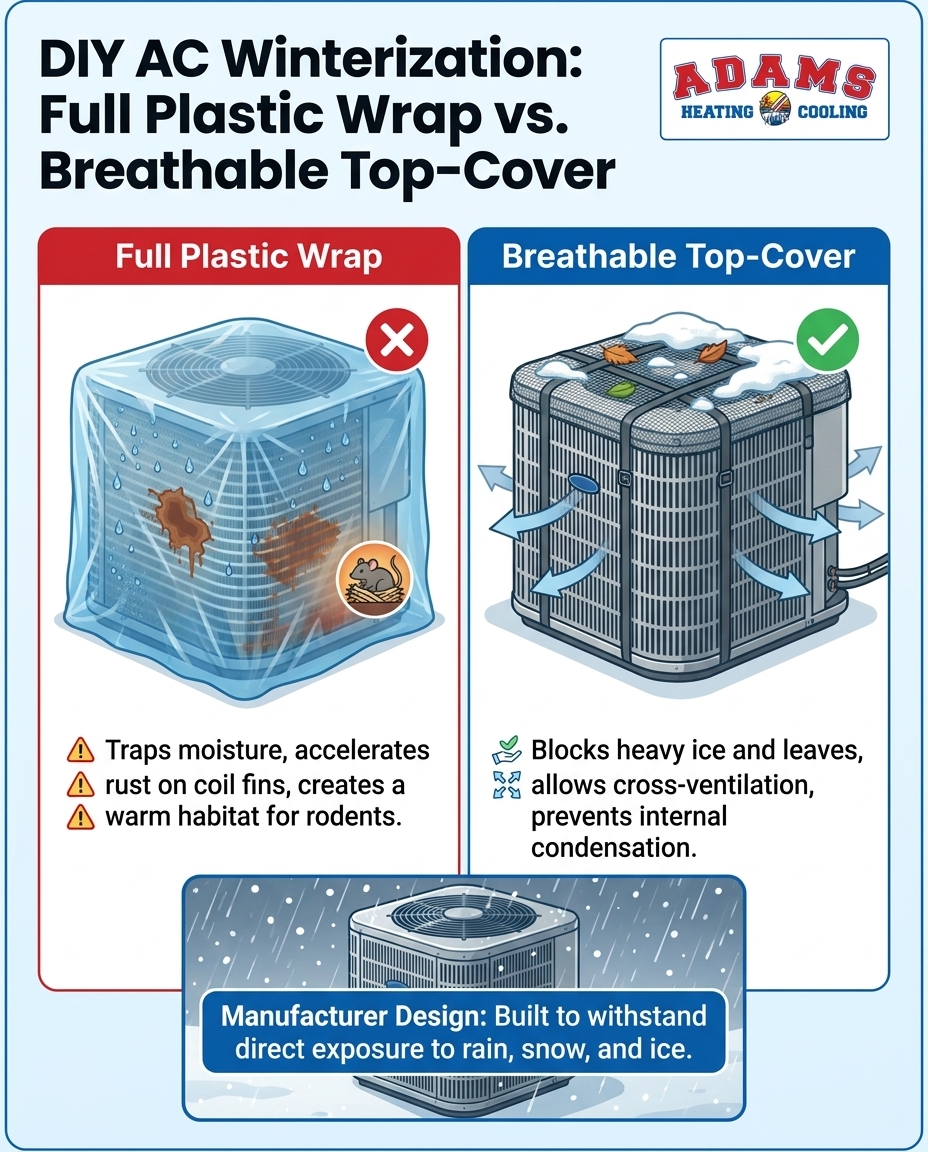
Every fall, well-meaning homeowners head to the hardware store, purchase heavy-duty plastic tarps, and completely seal their outdoor AC condensers from top to bottom. They wrap the unit tightly, securing it with bungee cords, believing they have created an impenetrable fortress against snow and ice. The core thesis you need to understand is this: manufacturer designs are already built to handle the outdoor elements, but trapping moisture inside a plastic bubble destroys the unit from the inside out.
As you tackle your early fall yard work, you face a critical decision point: you can either fully seal the unit and invite severe internal damage, or you can use a simple, breathable top-cover that actually helps your system survive the off-season. For professional guidance on keeping your cooling system in peak condition, explore our comprehensive Air Conditioning services.
Why Fully Wrapping Your AC Condenser Causes More Harm Than Good
To understand why a heavy plastic tarp is so destructive, you have to look at the thermodynamic reality of what happens under that cover during a long Michigan winter. Air conditioner condensers are not fragile appliances; they are manufactured with highly durable, weather-resistant finishes specifically designed to withstand direct rain, snow, sleet, and ice.
When you wrap the unit in plastic, you interrupt its ability to breathe. Even in the dead of winter, moisture constantly rises from the ground. When lake-effect snow hits the Kalamazoo MI area, followed by our typical fluctuating freeze-thaw cycles, the environment around your AC unit becomes incredibly dynamic. Snow accumulates around the base of the unit, melts during a sunny afternoon, and turns into water vapor. Because the plastic tarp blocks all airflow, that rising moisture has nowhere to go.
Instead of evaporating safely into the atmosphere, the moisture hits the cold underside of the plastic tarp and condenses. This creates a highly humid, greenhouse-like microclimate right inside your AC unit. The lack of airflow prevents any evaporation, leaving the internal components constantly damp for months on end. You might think you are shielding the unit from the weather, but you are actually subjecting it to a localized, high-humidity rainstorm that never stops.
The Myth of Element Protection
A persistent myth in home maintenance is that outdoor units are delicate machines that need to be "kept warm" or shielded from standard precipitation. This is simply not true. The internal coils, the fan blades, and the compressor are all engineered for outdoor life. In fact, if you read standard HVAC manufacturer guidelines, they explicitly warn against restricting airflow around the condenser, even during the off-season.
Manufacturers design these units to get wet and then dry out quickly via natural wind and airflow. When you remove the wind from the equation by wrapping the unit, you defeat the manufacturer's built-in defense mechanisms against moisture.
The Hidden Rust Threat: How Trapped Condensation Destroys Internal Components
The most severe consequence of trapping moisture under a plastic tarp is the accelerated rust and corrosion it causes. Your AC condenser is packed with delicate components, most notably the aluminum fins and copper coils that facilitate heat transfer. When exposed to constant, trapped humidity, these metals undergo an accelerated oxidation process.
This isn't just cosmetic surface rust. The corrosion eats away at the thin metal fins, causing them to become brittle and crumble. Furthermore, the trapped condensation settles on internal electrical components, including the contactor, capacitors, and wiring terminals. When moisture sits on these electrical connections for six months, it causes severe pitting and corrosion. When you finally turn the unit back on in the spring, these corroded connections often lead to electrical shorts, blown fuses, or even a completely fried compressor.
As your local Kalamazoo MI experts, our team at Adams Heating & Cooling frequently has to save homeowners from these self-inflicted, costly spring repairs. It is heartbreaking to tell a homeowner that their attempt to protect their unit is exactly what destroyed it. Worse still, rust damage caused by improper covering and restricted airflow is almost never covered by manufacturer warranties, because it violates the installation and care guidelines.
Comparing Winterization Methods:
• Moisture Level — Exposed to Elements (No Cover): Dries quickly via natural wind — Fully Wrapped in Plastic: Constantly damp and humid
• Airflow — Exposed to Elements (No Cover): Maximum cross-ventilation — Fully Wrapped in Plastic: Zero airflow; completely suffocated
• Rust Risk — Exposed to Elements (No Cover): Very low (designed for weather) — Fully Wrapped in Plastic: Extremely high (accelerated oxidation)
• Warranty Impact — Exposed to Elements (No Cover): Maintains warranty compliance — Fully Wrapped in Plastic: Often voids warranty due to negligence
The cost of repairing rust-damaged coils or replacing a shorted-out electrical panel far exceeds any perceived benefit of a cheap plastic tarp. Letting the unit breathe is always the safer financial choice.
The Rodent Risk: Creating a Winter Habitat Under the Tarp
Beyond rust and electrical failure, fully wrapping your AC unit introduces a secondary, highly destructive consequence: pest infestations. When the temperatures drop during our September fall-prep window, field mice, chipmunks, and other local rodents immediately begin searching for safe, wind-blocked shelters to survive the winter.
When you wrap your AC condenser tightly in a tarp, you are essentially building a luxury winter condominium for pests. The plastic blocks the biting winter wind, while the interior of the unit offers a dry, hidden space safe from predators. Once rodents move in, the real destruction begins.
Rodents do not just sleep inside the unit; they actively modify it to suit their needs. They are notorious for chewing through the protective insulation on your refrigerant lines to use as nesting material. Even worse, they frequently chew through the high-voltage electrical wiring, which not only destroys the system but creates a severe fire hazard. They also tend to build large nests right on top of the fan motor or wedged between the fan blades.
When you use a breathable top-cover instead of a full wrap, you leave the sides of the condenser completely exposed to the wind and cold. Without the wind-blocking protection of a tarp, rodents have zero interest in setting up camp inside your AC unit. This simple change in strategy prevents massive pest damage and connects directly back to the overarching theme: improper DIY winterization almost always results in unintended consequences.
What Actually Works: The Breathable Top-Cover Method
If full plastic wraps are so dangerous, what is the correct way to protect your outdoor unit? The answer is the breathable top-cover method. Because the Kalamazoo MI region averages over 70 inches of snow per year, you do need some top-protection from heavy ice accumulation and falling debris, but you must maintain cross-ventilation.
Here is exactly what you should use to safely protect your investment:
• Heavy-duty canvas top-covers: These specialized covers are designed to drop only three to four inches down the sides of the unit. They securely cover the top fan grille while leaving the entire side coil area open to the air.
• The plywood method: A highly effective DIY alternative is cutting a piece of heavy plywood to be just slightly larger than the top of the unit. Place it over the fan grille and weigh it down securely with a brick or cinder block.
• Debris prevention: The primary goal of a top-cover is simply to prevent falling autumn leaves, twigs, pine needles, and heavy ice chunks from dropping down through the fan grille and rotting inside the base pan.
• Cross-ventilation: By leaving the sides completely open, the wind can blow through the aluminum fins, instantly drying out any condensation or melting snow, keeping the internal components perfectly dry.
When securing any top-cover, be incredibly careful not to strap bungee cords tightly against the delicate aluminum fins on the sides of the unit. These fins bend very easily, and crushed fins restrict the system's ability to transfer heat when you turn it back on in the summer.
Your Early Autumn Yard Prep Timeline
Timing is everything when it comes to seasonal HVAC maintenance. You want to establish the correct timeline for preparing the AC unit before the harsh winter weather arrives, but after the majority of the yard debris has fallen.
Follow this safe, effective DIY timeline for your September fall-prep:
1. Early September (Observation): Keep an eye on the trees surrounding your property. Wait until the heaviest period of leaf-drop begins.
2. Mid-September (Clear the Area): Clear a strict two-foot radius around the entire AC condenser. Rake away leaves, trim back overgrown bushes, and remove any tall grass. This clear zone prevents snowdrifts from burying the unit and ensures maximum airflow.
3. Late September (Power Down): Locate the outdoor disconnect box mounted on the wall near your AC unit. Pull the disconnect block or flip the switch to the "off" position. This ensures the AC cannot accidentally kick on during an unseasonably warm fall day once you have covered the top fan.
4. Before the First Freeze (Install Top-Cover): Once the surrounding debris is cleared and the power is off, install your breathable top-cover or plywood board.
A critical warning: Never use a garden hose to wash down the outside of the unit if temperatures are expected to drop below freezing overnight. Any water trapped between the fins will expand as it freezes, potentially crushing the delicate internal tubing. For more seasonal guidance, read our guide to help you Prepare Your HVAC System for Winter.
Transitioning Your System: Pre-Winter Maintenance and Heating Checks
Winterizing the AC condenser is only half of the seasonal transition. As your cooling system goes to sleep, your heating system is waking up, and it requires equal attention. Proper fall prep isn't just about yard work; it is about ensuring the indoor equipment is safe, efficient, and ready to handle the freezing months ahead.
While clearing leaves and placing a top-cover are great DIY steps, they cannot replace professional ongoing maintenance. A professional fall tune-up addresses the internal components of both your furnace and your A/C that DIY yard prep simply cannot reach. Technicians check the heat exchanger for cracks, test the safety limits, calibrate the thermostat, and inspect the blower motor.
We consistently see the long-term benefits of this proactive approach. In one recent case, a local homeowner scheduled ongoing maintenance for their furnace and A/C units over several years. By having our technicians regularly inspect and clean the equipment, both units have been kept in good running condition for years without unexpected breakdowns. Scheduling an inspection early in the season is the best way to avoid emergency heating failures on the coldest night of the year.
Common Questions About Winterizing Your AC Condenser
Should I cover my AC unit in the winter?
You should only cover the very top of your AC unit, never the entire machine. Using a breathable top-cover or a piece of plywood prevents leaves, twigs, and heavy ice from falling into the fan grille. Completely covering the unit restricts vital airflow and leads to severe internal damage.
What happens if I wrap my AC unit in plastic?
Wrapping your AC unit in plastic traps ground moisture and melting snow inside the unit, creating a highly humid microclimate. Because the plastic prevents the wind from drying the internal components, this trapped condensation accelerates rust, corrodes electrical wiring, and creates a sheltered habitat for rodents.
Do AC covers cause rust?
Full-length, non-breathable AC covers absolutely cause rust. By trapping moisture against the delicate copper coils and aluminum fins for months at a time, full covers accelerate galvanic corrosion. Breathable top-covers that leave the sides exposed do not cause rust because they allow the wind to dry the unit naturally.
How do you protect an outside AC unit from snow?
The best way to protect an outside AC unit from snow is to ensure there is a clear two-foot radius around the unit to prevent deep snowdrifts from burying it. Place a sturdy piece of plywood or a short canvas top-cover over the fan grille to stop heavy ice chunks from falling inside and damaging the fan blades.
When is the best time to winterize my outdoor AC unit?
The optimal time for September fall-prep is right after the majority of the autumn leaves have fallen, but before the first deep freeze hits your area. This ensures you can clear away the yard debris and place your top-cover before heavy ice and snow begin to accumulate.
Can mice get into my AC condenser during the winter?
Yes, mice and other rodents frequently seek shelter inside AC condensers during the winter. They are especially drawn to units that are fully wrapped in tarps, as the cover blocks the freezing wind. Leaving the sides of the unit exposed to the weather is the best way to deter pests from nesting in the electrical panel or fan blades.
Protect Your Investment and Schedule Your Fall Inspection Today
Following clear, actionable advice when winterizing your AC condenser prevents incredibly costly DIY mistakes. By skipping the heavy plastic tarp and opting for a breathable top-cover, you protect your system from rust, rodents, and electrical failure. However, while you handle the outdoor yard prep, it is vital to leave the internal mechanical maintenance to the professionals.
To ensure your home comfort systems are protected, efficient, and ready for whatever the winter weather brings, explore our ongoing service options. Secure your peace of mind and sign up for our Maintenance Plan today.
Customer Testimonials

In the past 18 months, Adams has installed a new Amana air conditioning system, and new filtration and humidification systems at my home. The installers were all very courteous, professional and knowledgeable. Their work was simply superb... reasonably priced, and performed on time and to perfection! I enthusiastically recommend Adams, without reservation!
As usual, Adams Heating and Cooling exceeded our expectations. The quote was done in a timely manner, pricing was fair, installation was quick and the job was done right! Rob is great to work with. Adams is first on our list!
Called these guys off of a referral from a friend. Home furnace failure in sub-zero temperatures, late at night. Dan was there in an hour. Friendly, polite, professional and most importantly, very competent. Diagnosed and fixed the problem in under an hour. After hours 24/7 pricing was surprisingly reasonable. This outfit gets straight A+ from us.
Excellent service! We had them replace our heater, AC, and water heater as a package deal. They even helped with financing as it was a large expense to address at one time. It left us with peace of mind that all the mechanicals in our home were new!
They have always been there for us and did so again by responding quickly to put in a new furnace after a lighting strike caused a power surge. In addition, their electrician came by to help with other issues caused by the strike. Everyone we work with from the who answers the phone to who shows up to complete the work are polite, pleasant and professional! And quick to respond and on time!
From the service call to the installation with Dan, Dave, and Daniel… our experience was top notch. They quickly came out, identified the problem, and installation of our new unit took less than 3 hours. Can’t recommend Adams enough!
Dan, Dave and Mike were phenomenal! Very patient, listened to my questions/concerns, and made sure that everything was working and that my Nest was working correctly, before leaving. Thank you so much for your service!
Service was excellent! Had a new furnace installed. The technicians did a wonderful job and completed the installation quickly. Mike answered my questions and followed up to verify the worke done. I was charged just as I was quoted. Have used Adam's for repairs in the past and I'm always pleased. Great work!
I had a boiler and water heater replacement/upgrade. I went from an 84% efficient boiler to a 95% efficient. I dont recall the water heater's efficiency. That was upgraded to an indirect water heater. Josh and Brad did a great job. The work looks great. The boiler and water heater work as to be expected. Their customer service is excellent. I will definitely be calling then when my basement remodel is ready to start.
I have had Adam's Heating and Cooling out at my house before, so I called them for some gas line work. The estimator was very helpful and let me know the best way to be ready for when the work is scheduled so they can test the generator after they install the gas line to the meter and also let me know how to take care of another issue I had that would be helpful. I look forward to getting this work done and working with them.

Financing
Flexible financing options are available to help you get the comfort you need without the upfront financial stress.