

Why Your New Water Heater Quote Includes an Expansion Tank
Are you looking at a replacement quote for your home's plumbing system and wondering why there is an unfamiliar "expansion tank" listed on the invoice? It is completely natural to question new components, especially if your old water heater ran for over a decade without one. Many homeowners assume this small, basketball-sized tank is an optional accessory or an unnecessary add-on. However, modern plumbing systems operate very differently than they did twenty years ago, making this component a physical necessity rather than a suggestion.
As we move through the September and early fall transition, the incoming groundwater temperatures begin to drop significantly. This seasonal shift sets the stage for increased thermal expansion when that freezing cold water enters your home and is rapidly heated. Without a way to manage this physical reaction, your plumbing system absorbs a massive amount of stress. To ensure your home is protected, partnering with a team that provides comprehensive professional HVAC and plumbing services is the best way to guarantee your new equipment is installed safely, transparently, and correctly from day one.
The Physics of Thermal Expansion in Your Plumbing
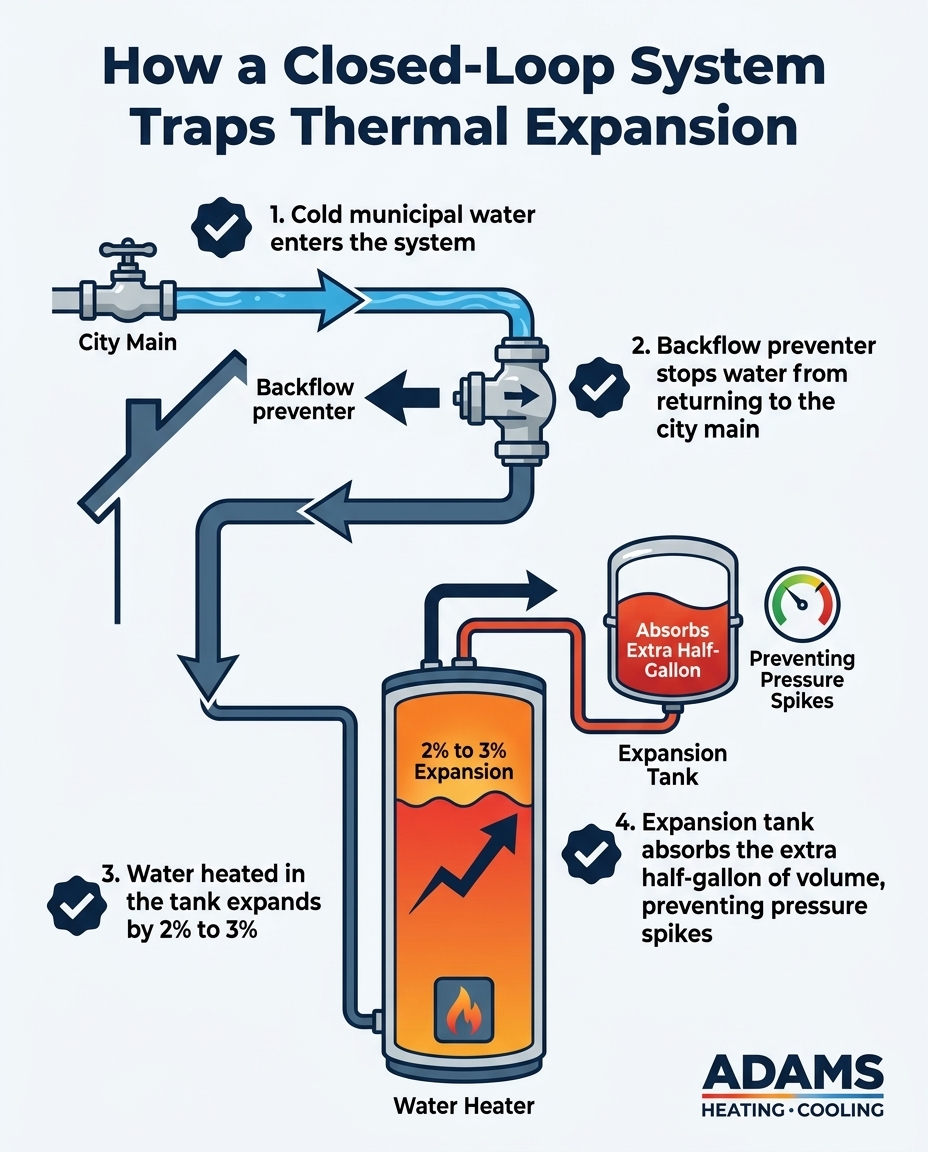
To understand why an expansion tank is required, you first have to understand the basic thermodynamics happening inside your utility room every single day. When water is heated, its molecular structure becomes more active, causing the water to expand in volume. In a standard plumbing environment, water expands by roughly 2% to 3% when heated from ground temperature to a safe, comfortable bathing temperature.
While 2% might sound insignificant, it translates to a massive amount of physical mass in a closed container. In a standard 50-gallon water heater, that thermal expansion creates up to a half-gallon of extra water volume. Water is virtually incompressible, meaning that extra half-gallon cannot simply be squeezed into a smaller space. If the water has nowhere to expand, it immediately converts that extra volume into severe outward pressure against the steel walls of the tank and the copper or PEX piping throughout your home. This is why a professional water heater installation must account for this physical law to prevent long-term damage.
Why Cold Groundwater Changes the Equation
The amount of thermal expansion your system experiences is directly tied to the temperature delta—the difference between the incoming cold water and your tank's hot water setting. In our region, Kalamazoo municipal water systems and local wells deliver extremely cold water, particularly as fall turns into winter.
When groundwater enters your home at 40°F and needs to be heated to 120°F, the heating element or gas burner has to work significantly harder, and the temperature shift is drastic. The greater the temperature shift, the more the water volume expands. This makes the physical stress on your water heater much higher in colder climates compared to homes in warmer southern regions where groundwater remains relatively temperate year-round.
Understanding Closed-Loop vs. Open-Loop Systems
The most common question homeowners ask is, "My old water heater didn't have an expansion tank, so why do I suddenly need one now?" The answer lies in how municipal water supplies have changed their infrastructure to protect public health. Historically, homes operated on what is known as an open-loop plumbing system. Today, nearly all modernized homes operate on a closed-loop system.
• Water Flow Direction — Open-Loop Plumbing System (Historical): Water could flow freely in both directions between the home and the city main. — Closed-Loop Plumbing System (Modern): Water can only flow into the home; a one-way valve prevents reverse flow.
• Thermal Expansion Relief — Open-Loop Plumbing System (Historical): Expanding hot water simply pushed backward out of the house and into the public water main. — Closed-Loop Plumbing System (Modern): Expanding water is trapped inside the home's plumbing with nowhere to go.
• Contamination Risk — Open-Loop Plumbing System (Historical): High risk. Contaminated water from a home could flow back into the public drinking supply. — Closed-Loop Plumbing System (Modern): Zero risk. Public drinking water is fully protected from household cross-contamination.
• Expansion Tank Need — Open-Loop Plumbing System (Historical): Not strictly required, as the city water main acted as a giant expansion tank. — Closed-Loop Plumbing System (Modern): Absolutely mandatory to absorb the trapped pressure and prevent pipe damage.
To protect the community's drinking water from contamination, Kalamazoo municipal water systems and other local authorities now require backflow preventers or check valves on the main water line. A backflow preventer is a one-way street: water can enter your home, but it can never flow backward into the public supply.
The moment a backflow preventer is installed on your water meter, your home becomes a closed-loop system. The expanding water generated by your water heater is now entirely trapped behind closed doors. Without the city main to absorb that extra half-gallon of volume, the pressure inside your home's pipes will skyrocket every time the burner kicks on. The thermal expansion tank is specifically designed to replace the pressure-relief function that the city water main used to provide.
What Happens If You Skip the Expansion Tank?
If you have a closed-loop system and choose to install a water heater without a thermal expansion tank, the physics of heated water will quickly begin to tear your plumbing apart. Water pressure is relentless, and when it has nowhere to expand, it finds the weakest points in your system. Skipping this vital component sets off a specific sequence of destructive events.
1. Extreme Pressure Spikes: Normal municipal water pressure sits between 50 and 70 PSI (pounds per square inch). When a closed-loop water heater fires up without an expansion tank, the trapped thermal expansion can cause the internal pressure to rapidly spike to 130 PSI or higher.
2. T&P Valve Activation: Every water heater is equipped with a Temperature and Pressure (T&P) relief valve, designed as a last-resort safety mechanism. When pressure exceeds 150 PSI, this valve will forcefully open to discharge water and prevent the tank from rupturing. If you notice your valve weeping or dripping constantly, it is crying out for an expansion tank.
3. Accelerated Wear on Pipe Joints: The daily cycle of pressure spiking and dropping causes copper pipes, PEX fittings, and solder joints to flex. Over time, this constant stretching and contracting weakens the joints, leading to pinhole leaks behind your walls or above your ceilings.
4. Premature Equipment Failure: The steel walls of the water heater itself will suffer from metal fatigue. The constant ballooning effect weakens the glass lining inside the tank, leading to rust, corrosion, and an early death for your brand-new equipment.
One local homeowner experienced this cascading effect firsthand when their hot water heater failed shortly after a minor fix had been attempted on the plumbing. Because the underlying pressure issues were not addressed, the tank gave out. A technician arrived, offered a range of proper replacement options, scheduled the installation of a new, fully compliant heater, and left the utility area spotless—even crediting the cost of the initial diagnostic visit. This scenario highlights why catching pressure issues early and installing the right protective components is so vital. If you are already researching signs of a leaking water heater, trapped thermal expansion is one of the most common hidden culprits.
Building Codes and Code-Compliant Installations
Because the dangers of trapped thermal expansion are so well documented, regulatory bodies have stepped in to protect homeowners. The International Plumbing Code (IPC) and the Uniform Plumbing Code (UPC) both strictly mandate the installation of thermal expansion tanks on all closed-loop water heating systems. These codes are not arbitrary rules designed to make home upgrades more difficult; they are written in direct response to decades of property damage caused by ruptured tanks and burst pipes.
When a municipal building inspector reviews a new water heater installation, the presence of a properly sized and supported expansion tank is one of the very first things they check. If the tank is missing, the installation fails inspection. Building codes are continually updated to reflect modern safety standards, which is why a tank that wasn't required in 1998 is absolutely mandatory today.
We focus on transparent communication and code-compliant professional installation because we believe in protecting homeowners from unexpected water damage and sticker shock. We want you to understand exactly what you are paying for and why it matters. For example, when a recent customer needed a new electric hot water heater alongside an electrical panel upgrade, our team ensured both systems were brought fully up to code, rewiring the basement runs efficiently so the home was completely safe and compliant. Doing the job right the first time is always less stressful than dealing with a failed inspection or a flooded basement later.
Protecting Your Investment Long-Term
It helps to think of a thermal expansion tank not as an added expense, but as a heavy-duty shock absorber for your entire house. Just as the suspension on your car absorbs the impact of potholes to protect the chassis, the expansion tank absorbs the daily pressure spikes of heated water to protect your plumbing infrastructure.
How the Internal Bladder Works
Inside the steel shell of an expansion tank is a flexible rubber diaphragm or bladder. On one side of this bladder is the water from your plumbing system; on the other side is highly pressurized air. Because air can be compressed (unlike water), the expanding hot water pushes against the rubber bladder, compressing the air cushion. Once you turn on a faucet and relieve the system pressure, the compressed air pushes the water back out of the tank. This seamless, invisible process happens multiple times a day.
By preventing massive pressure fluctuations, the expansion tank extends the lifespan of much more than just the water heater. It actively protects:
• Rubber gaskets and O-rings: Found inside every faucet and showerhead in your home, which degrade quickly under high pressure.
• Toilet fill valves: Which can easily blow out or begin leaking continuously if subjected to 130+ PSI.
• Appliance hoses: Particularly washing machine and dishwasher supply lines, which are prone to bursting under extreme water pressure.
• Manufacturer warranties: Almost all major water heater manufacturers will immediately void the warranty on a leaking tank if they determine it was installed on a closed-loop system without an expansion tank.
To ensure this shock absorber keeps working year after year, the air pressure inside the tank must be checked and calibrated periodically. The rubber bladder can lose air over time, just like a car tire. Enrolling in a preventative maintenance plan ensures a licensed technician tests the expansion tank's pressure during your annual tune-up, keeping your warranty intact and your plumbing safe.
Planning Your Professional Water Heater Replacement
Installing an expansion tank is not a simple matter of threading a part onto a pipe. It requires specific calculations to ensure the system works safely. A licensed technician must first measure your home's static incoming water pressure using a gauge. They then take the total gallon capacity of your new water heater and cross-reference it with the static pressure to select the exact volume and pre-charge pressure required for your specific expansion tank.
If the tank is undersized, it will not absorb enough volume, and the T&P valve will still leak. If the tank is improperly pressurized before installation, the rubber bladder can rupture on the very first day. Furthermore, the tank must be physically supported in a way that prevents its heavy, water-filled weight from snapping the copper lines it is attached to. Because these calculations and structural requirements are so precise, attempting a DIY installation is highly discouraged and can lead to catastrophic leaks.
When you are planning your system upgrade, always look for comprehensive quotes that transparently include all necessary safety components upfront. A trustworthy provider will never hide the cost of an expansion tank only to spring it on you halfway through the job. If you are concerned about the total investment of bringing an older home's plumbing up to modern closed-loop codes, ask about financing options. Flexible payment arrangements can help you manage the cost of a full, code-compliant system upgrade without cutting corners on essential safety features.
Frequently Asked Questions About Water Heater Expansion Tanks
What is a closed-loop plumbing system?
A closed-loop plumbing system is one where water can enter the home from the municipal supply, but cannot flow backward out of the home. This one-way flow is created by the installation of a backflow preventer, check valve, or pressure-reducing valve on the main water line. Municipalities require these valves to ensure that contaminated water from a household never accidentally siphons back into the public drinking water supply. Because the water is trapped inside the home, any thermal expansion caused by the water heater has nowhere to go, requiring an expansion tank to manage the pressure.
What happens if my water heater doesn't have an expansion tank?
If your closed-loop system lacks an expansion tank, the heated water will expand and cause severe pressure spikes throughout your home's plumbing. The most immediate symptom is usually the Temperature and Pressure (T&P) relief valve on the water heater constantly dripping or discharging water onto the floor as it tries to vent the dangerous pressure. Over time, these daily pressure spikes will weaken pipe joints, blow out toilet fill valves, and cause the steel walls of the water heater to fatigue and rupture prematurely. Skipping the tank almost always guarantees you will be paying for a flooded utility room or an early tank replacement.
Are expansion tanks required for all water heaters?
Expansion tanks are legally required by the International Plumbing Code (IPC) and Uniform Plumbing Code (UPC) for any water heater installed on a closed-loop system. If your home operates on an open-loop system—meaning there are absolutely no check valves, backflow preventers, or pressure-reducing valves between your home and the city main—an expansion tank may not be strictly required by code. However, because almost all modern municipalities are aggressively upgrading their meters to include backflow preventers, the vast majority of homes today are closed-loop and therefore require the tank.
How long does a thermal expansion tank typically last?
A typical thermal expansion tank lasts between five and eight years, which is often slightly shorter than the lifespan of the water heater itself. The lifespan depends heavily on the incoming municipal water pressure, the quality of your home's water, and whether the tank was properly pressurized during the initial installation. Over time, the internal rubber bladder can degrade, or the air valve can slowly leak pressure, causing the tank to become "waterlogged." During annual plumbing maintenance, a technician will tap the tank and check the air valve to ensure it is still functioning correctly.
Can I install a water heater expansion tank myself?
Installing an expansion tank is not recommended as a DIY project because it requires professional calculations, specialized tools, and a thorough understanding of building codes. A licensed technician must measure your home's static water pressure to properly pre-charge the air side of the expansion tank before installation; failing to do this will cause the internal bladder to rupture immediately. Additionally, the tank must be properly supported with specific brackets or strapping, as a tank full of water becomes incredibly heavy and can easily snap unsupported copper pipes, leading to a massive indoor flood.
Get Expert Guidance on Your Water Heater Installation
Ultimately, seeing an expansion tank on your new water heater quote is not a sign of an unnecessary upsell; it is proof that your technician is designing a system that meets modern safety codes and respects the physics of thermal expansion. In a closed-loop plumbing system, this small tank serves as a vital protector, absorbing the intense daily pressure spikes that would otherwise destroy your pipes, your fixtures, and the water heater itself.
If you are preparing for a replacement ahead of the colder months and want to ensure your new equipment is installed safely, legally, and reliably, it pays to seek professional advice. We believe in providing clear, logic-based explanations for every component we install so you can make informed decisions about your property. Reach out today to schedule a consultation or a thorough plumbing inspection, and let our licensed experts design a code-compliant water heating system that will keep your home safe and comfortable for years to come.
Customer Testimonials

In the past 18 months, Adams has installed a new Amana air conditioning system, and new filtration and humidification systems at my home. The installers were all very courteous, professional and knowledgeable. Their work was simply superb... reasonably priced, and performed on time and to perfection! I enthusiastically recommend Adams, without reservation!
As usual, Adams Heating and Cooling exceeded our expectations. The quote was done in a timely manner, pricing was fair, installation was quick and the job was done right! Rob is great to work with. Adams is first on our list!
Called these guys off of a referral from a friend. Home furnace failure in sub-zero temperatures, late at night. Dan was there in an hour. Friendly, polite, professional and most importantly, very competent. Diagnosed and fixed the problem in under an hour. After hours 24/7 pricing was surprisingly reasonable. This outfit gets straight A+ from us.
Excellent service! We had them replace our heater, AC, and water heater as a package deal. They even helped with financing as it was a large expense to address at one time. It left us with peace of mind that all the mechanicals in our home were new!
They have always been there for us and did so again by responding quickly to put in a new furnace after a lighting strike caused a power surge. In addition, their electrician came by to help with other issues caused by the strike. Everyone we work with from the who answers the phone to who shows up to complete the work are polite, pleasant and professional! And quick to respond and on time!
From the service call to the installation with Dan, Dave, and Daniel… our experience was top notch. They quickly came out, identified the problem, and installation of our new unit took less than 3 hours. Can’t recommend Adams enough!
Dan, Dave and Mike were phenomenal! Very patient, listened to my questions/concerns, and made sure that everything was working and that my Nest was working correctly, before leaving. Thank you so much for your service!
Service was excellent! Had a new furnace installed. The technicians did a wonderful job and completed the installation quickly. Mike answered my questions and followed up to verify the worke done. I was charged just as I was quoted. Have used Adam's for repairs in the past and I'm always pleased. Great work!
I had a boiler and water heater replacement/upgrade. I went from an 84% efficient boiler to a 95% efficient. I dont recall the water heater's efficiency. That was upgraded to an indirect water heater. Josh and Brad did a great job. The work looks great. The boiler and water heater work as to be expected. Their customer service is excellent. I will definitely be calling then when my basement remodel is ready to start.
I have had Adam's Heating and Cooling out at my house before, so I called them for some gas line work. The estimator was very helpful and let me know the best way to be ready for when the work is scheduled so they can test the generator after they install the gas line to the meter and also let me know how to take care of another issue I had that would be helpful. I look forward to getting this work done and working with them.

Financing
Flexible financing options are available to help you get the comfort you need without the upfront financial stress.