

When You Lose Hot Water, Every Hour Counts
Your morning shower suddenly runs freezing cold, and a quick trip to the basement reveals a puddle spreading across the utility room floor. In that stressful moment, you might wonder why we stock high-demand water heater sizes on our trucks for same-day fixes. The answer is simple: when you lose hot water unexpectedly, every hour counts. Losing hot water turns daily routines upside down, making rapid replacement a top priority for homeowners facing early fall cold snaps in Kalamazoo. Washing dishes, doing laundry, and getting ready for work all come to a grinding halt until the system is restored.
Many local contractors advertise 24/7 availability, but being available for a late-night diagnosis does not guarantee the parts are actually on hand to complete the job. It is incredibly frustrating to pay for an emergency service call only to be told that the replacement tank will not arrive for another two days. We made a deliberate operational decision to rethink how we dispatch our teams, ensuring we can provide comprehensive home comfort services without unnecessary delays.
By carrying our own inventory directly to your driveway, we eliminate the frustrating waiting period. This proactive approach means we can seamlessly complete your water heater replacement and service in a single visit. You do not have to rearrange your work schedule for a second appointment or boil water on the stove just to wash your face. From the moment our technician arrives, the goal is total restoration of your home's comfort.
The Hidden Delay in Plumbing and HVAC Replacements
Homeowners often assume a delay in plumbing or HVAC repairs is due to a shortage of available technicians, but the real bottleneck is usually the industry supply chain. Most standard service vehicles are outfitted to carry basic hand tools, diagnostic equipment, and small repair components like thermocouples or heating elements. Because large equipment takes up valuable cargo space, standard practice dictates that technicians diagnose the problem first, then leave the property to acquire the necessary heavy equipment.
When a major component fails, the technician must drive across town to visit a local wholesale supply house. These supply house trips can add hours to a relatively straightforward job. If the supply house is out of stock, the technician has to order the unit from a regional distribution center, pushing the final installation to the next day—or even the next week. This "middle-man" delay leaves families frustrated and without basic comforts while waiting for parts to physically arrive in the city.
The Cost of Waiting on Supply Houses
The logistics of relying on third-party supply houses create severe limitations, especially during off-hours. Supply houses operate on standard commercial business hours and are typically closed on evenings and weekends. If your tank bursts on a Friday afternoon, a traditional contractor might diagnose the issue by 5:00 PM, but they cannot physically acquire the replacement tank until Monday morning.
• Initial Visit — Traditional Contractor Approach: Technician arrives, diagnoses the failure, and writes an estimate. — Our Mobile Warehouse Approach: Technician arrives, diagnoses the failure, and writes an estimate.
• Part Acquisition — Traditional Contractor Approach: Technician leaves your home to drive to a commercial supply house. — Our Mobile Warehouse Approach: Technician walks out to the fully stocked service truck in your driveway.
• Wait Time — Traditional Contractor Approach: Hours of driving and waiting at the counter, or days if the supplier is closed. — Our Mobile Warehouse Approach: Zero wait time. The exact tank needed is already on-site.
• Resolution — Traditional Contractor Approach: Requires a second appointment and prolonged disruption to your routine. — Our Mobile Warehouse Approach: Same-day installation completed during the initial service call.
This logistical breakdown highlights why the standard industry procedure fails homeowners during emergencies. The traditional steps—diagnose, leave, order, wait, and return—simply do not align with the urgency of a flooded basement or a freezing house.
Our Solution: Mobile Warehouses on Wheels
To bypass these industry-standard delays, we treat our service trucks as mobile warehouses. This is a fundamental shift from how most local companies operate. Instead of viewing our vehicles merely as transportation from point A to point B, we view them as fully functional, self-contained inventory hubs. This proactive inventory management means the technician who arrives to diagnose the problem already has the necessary equipment to solve it immediately.
What exactly makes a truck a mobile warehouse?
• Heavy equipment stock: We carry the actual replacement tanks, not just the repair parts.
• Comprehensive fittings: Bins are stocked with every variation of copper, PEX, and PVC fittings needed to adapt a new unit to older plumbing.
• Code-compliance gear: We carry expansion tanks, new venting materials, and drip pans to ensure the new installation meets current municipal safety codes.
• Safety and cleanup tools: Tarps, wet vacuums, and heavy-duty dollies are always on hand to protect your home during the extraction of the old, water-logged tank.
Eliminating the trip to the supply house translates directly to hours saved for the homeowner. It requires a significantly larger upfront investment in our fleet size, vehicle payload capacity, and daily inventory management, but it guarantees a superior customer experience. By carrying the supply house with us, we ensure that our fully stocked trucks allow for immediate same-day turnaround without waiting on third parties.
Why We Prioritize Standard 40 and 50-Gallon Tanks
You might wonder how we know exactly what to carry on our trucks given the wide variety of homes in the area. The answer lies in data. According to U.S. Department of Energy guidelines, standard 40 and 50-gallon tanks are the most common residential sizes, perfectly accommodating the hot water demands of households with 2 to 5 people. These two sizes represent the overwhelming majority of residential plumbing configurations.
By analyzing years of historical service data, we know exactly which units are most likely to fail and need immediate replacement. Stocking standard 40 and 50-gallon tanks ensures we have a direct, 1-to-1 match for the vast majority of residential emergencies we encounter. Carrying these specific sizes allows us to execute a flawless same-day swap without retrofitting headaches or forcing a homeowner to accept a tank that is improperly sized for their family's needs.
Matching the Right Tank to Your Home
While standard 40 and 50-gallon tanks cover most scenarios, ensuring the perfect fit requires professional verification. During the initial diagnostic, our technicians evaluate several critical factors before pulling a tank from the truck:
• Current household size: Has your family grown since the last tank was installed?
• Simultaneous usage: Do you frequently run the dishwasher, washing machine, and a shower at the same time?
• Physical space constraints: Will the new, heavily insulated modern tank physically fit into the existing utility closet?
• Energy source: Verifying the exact gas line sizing or electrical panel capacity required for the new unit.
Having both high-demand sizes on hand provides immediate flexibility. If a household has outgrown their old 40-gallon unit, we can seamlessly upgrade them to a 50-gallon tank on the spot, rather than making them wait days for a special order to arrive.
The Impact of Dropping Temperatures on Aging Water Heaters
The changing seasons play a massive role in when and why plumbing systems fail. As municipal groundwater temperatures drop, water heaters are forced to work significantly harder to reach comfortable output temperatures. In the summer, groundwater might enter your home at a mild 60 degrees. By late fall, that same water might enter the tank at 40 degrees or lower, drastically increasing the temperature gap the burner must overcome.
This added strain frequently exposes underlying vulnerabilities in older tanks. The prolonged heating cycles cause the metal tank to expand and contract more intensely, which can crack the internal glass lining. Once that lining is compromised, water reaches the steel exterior, and rust accelerates rapidly, leading to sudden failures. During early fall cold snaps in Kalamazoo, waiting overnight for a supply house order isn't just inconvenient—it's a severe comfort and safety issue for your family.
Recognizing the signs of a leaking water heater early can prevent a total blowout. Look for small pools of moisture near the base, listen for loud popping or rumbling noises during heating cycles, and pay attention to rusty discoloration in your hot water. If you catch these symptoms early, replacement can be scheduled proactively. But if a sudden rupture does happen, our mobile warehouses ensure we are ready to respond immediately.
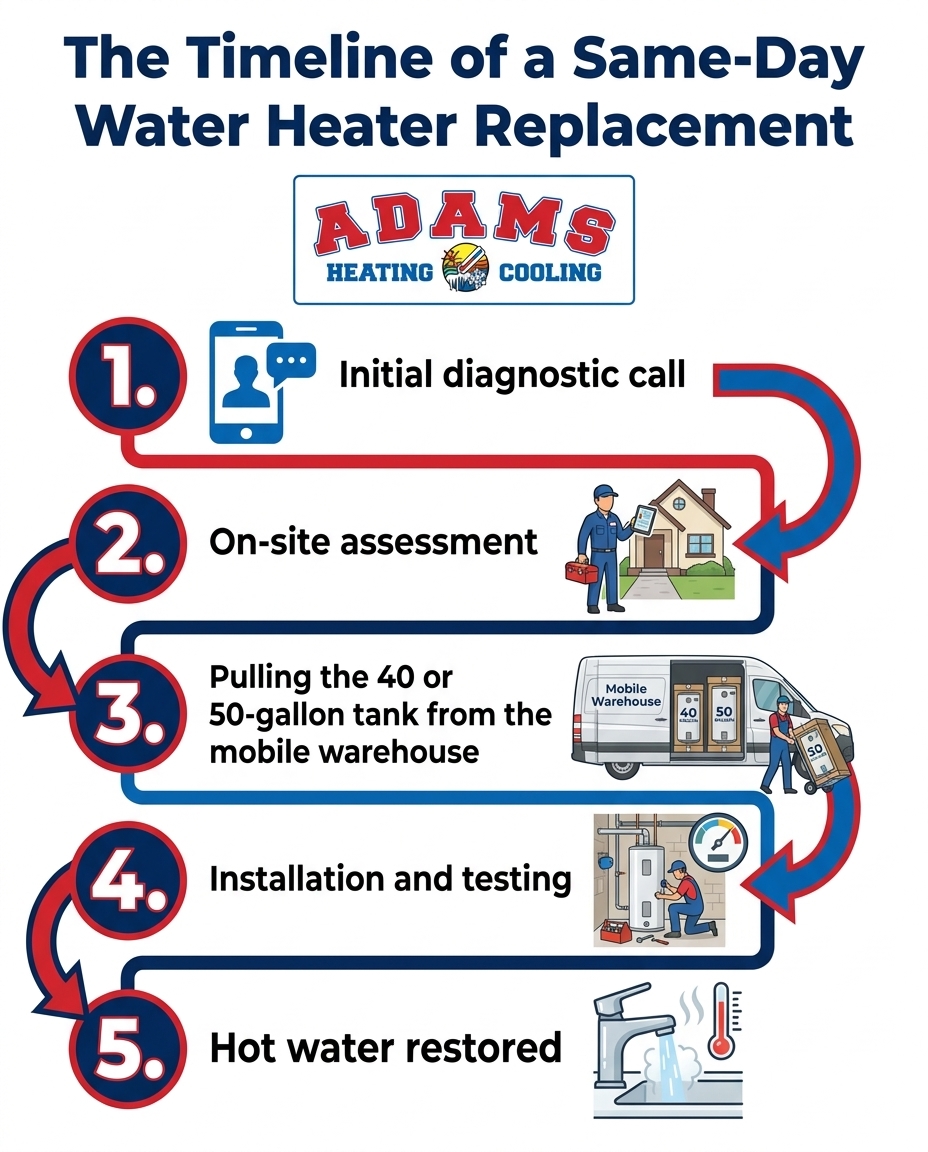
From Diagnosis to Same-Day Fixes: How Our Process Works
Understanding the theory behind our inventory management is one thing, but seeing it in action provides true peace of mind. When your system is on the fritz, our streamlined process ensures you are never left guessing about the next steps or the final outcome.
1. Comprehensive On-Site Diagnostic: Our technicians arrive ready to perform a full system evaluation. We do not just look at the puddle on the floor; we test the heating elements, inspect the gas valves, check the venting, and assess the structural integrity of the tank.
2. Transparent Options and Upfront Planning: If a minor fix isn't enough and the unit has permanently failed, we provide clear, transparent options upfront. You will know exactly what the replacement entails before any tools are lifted. If a full replacement is needed, we can often utilize flexible financing options to help ease the unexpected burden.
3. Immediate Same-Day Installation: Because we do not make you reschedule or wait for a supply house run, we pull the replacement directly from our truck. The old unit is safely drained and removed, and the new tank is maneuvered into place.
4. Testing, Cleanup, and Restoration: We meticulously test the new system for proper pressure, safe venting, and optimal temperature output. Our goal is to leave the work area cleaner than we found it and ensure you are back in hot water before we drive away.
Recently, a local homeowner reached out when their hot water heater was on the fritz and failing to produce enough heat for their family. Because our trucks are fully stocked, our technician provided same-day service, diagnosed the underlying internal failure, and performed the replacement immediately. The customer was back in hot water that same afternoon with transparent options provided upfront.
Handling Unexpected Complications On-Site
Sometimes a replacement requires more than just swapping a tank. Older homes frequently require minor code updates, such as installing a thermal expansion tank, upgrading the exhaust venting, or performing basic electrical checks to ensure the breaker is properly sized for modern equipment. Because our trucks are fully stocked for comprehensive service, we can handle these necessary adjustments in the same visit, preventing any further delays to your installation.
Protecting Your Investment After the Installation
Once your new water heater is installed and your daily routine is back on track, protecting its lifespan becomes the next priority. Modern tanks are built to be highly efficient, but they still require proactive care to reach their maximum expected lifespan. Ignoring a new tank for a decade is a guaranteed way to invite premature failure and reduced energy efficiency.
Regular flushing is one of the most critical maintenance tasks. Over time, naturally occurring minerals in the municipal water supply settle at the bottom of the tank, creating a thick layer of sediment. This sediment acts as an insulator between the heat source and the water, forcing the system to work harder and dramatically increasing the risk of overheating the tank floor. Additionally, routine anode rod inspections prevent internal corrosion. The sacrificial anode rod is designed to attract corrosive elements in the water, rusting itself away so the steel tank does not. Once the rod is fully depleted, the tank itself begins to rust.
Enrolling in routine preventative maintenance ensures that a professional keeps an eye on the system year after year. We will handle the heavy lifting of flushing the tank, testing the pressure relief valves, and checking the anode rod depletion levels. Proactive care drastically reduces the chances of experiencing another sudden failure down the road, keeping your energy bills low and your showers hot.
Frequently Asked Questions About Water Heater Replacements
Can a water heater be replaced in one day?
Yes, a water heater can absolutely be replaced in a single day when the contractor is properly prepared. The actual physical removal of the old tank and installation of the new one typically takes just a few hours. The determining factor for same-day service is whether the contractor has the correct replacement tank and necessary fittings already stocked on their truck, eliminating the need to wait for a supply house order.
Why does it sometimes take so long to get a water heater replaced?
The most common cause of delayed replacements is a broken supply chain. Many plumbing and HVAC companies do not carry large inventory on their service vehicles, meaning they must diagnose the issue, leave your home to purchase the tank from a commercial wholesaler, and then return. If the wholesaler is closed for the evening or out of stock, the installation gets pushed to the following days.
What size water heater is standard for most homes?
The standard sizes for most residential homes are 40-gallon and 50-gallon tanks. A 40-gallon tank typically provides enough hot water for a household of 2 to 3 people, while a 50-gallon tank is better suited for homes with 3 to 5 people. The right size depends on your family's simultaneous water usage, such as running a dishwasher and a shower at the same time.
How do I know if my water heater needs to be replaced rather than repaired?
A unit usually requires full replacement if the steel tank itself is leaking, as a cracked glass lining cannot be repaired. Other strong indicators for replacement include the tank being over 10 to 12 years old, severe internal rusting causing discolored water, or repeated component failures that make ongoing repairs cost-prohibitive compared to investing in a new, efficient model.
Does cold weather affect how my water heater performs?
Yes, dropping temperatures significantly impact performance. During the colder months, the groundwater entering your home is much colder than in the summer. This requires the burner to run longer and work harder to raise the water to your desired thermostat setting. This prolonged thermal expansion puts extra stress on aging metal tanks, often triggering leaks or outright failures during early fall and winter cold snaps.
Don't Let Supply Chain Delays Keep You in the Cold
Understanding how our behind-the-scenes inventory management works means you can have total peace of mind knowing a sudden failure won't leave you waiting days for a solution. The traditional model of driving back and forth to supply houses simply does not serve the homeowner's best interests during an emergency. By treating our trucks as mobile warehouses and proactively stocking the most vital equipment, we ensure faster, same-day resolutions for your home.
You deserve a contractor who values your time and comfort enough to arrive fully prepared for the job. By carrying standard 40 and 50-gallon tanks directly to your driveway, we eliminate the middle-man and restore your routine immediately. If you are experiencing issues with your system, explore our water heater replacement and service options today, and experience exactly how our inventory management translates to a faster resolution for your specific emergency.
Customer Testimonials

In the past 18 months, Adams has installed a new Amana air conditioning system, and new filtration and humidification systems at my home. The installers were all very courteous, professional and knowledgeable. Their work was simply superb... reasonably priced, and performed on time and to perfection! I enthusiastically recommend Adams, without reservation!
As usual, Adams Heating and Cooling exceeded our expectations. The quote was done in a timely manner, pricing was fair, installation was quick and the job was done right! Rob is great to work with. Adams is first on our list!
Called these guys off of a referral from a friend. Home furnace failure in sub-zero temperatures, late at night. Dan was there in an hour. Friendly, polite, professional and most importantly, very competent. Diagnosed and fixed the problem in under an hour. After hours 24/7 pricing was surprisingly reasonable. This outfit gets straight A+ from us.
Excellent service! We had them replace our heater, AC, and water heater as a package deal. They even helped with financing as it was a large expense to address at one time. It left us with peace of mind that all the mechanicals in our home were new!
They have always been there for us and did so again by responding quickly to put in a new furnace after a lighting strike caused a power surge. In addition, their electrician came by to help with other issues caused by the strike. Everyone we work with from the who answers the phone to who shows up to complete the work are polite, pleasant and professional! And quick to respond and on time!
From the service call to the installation with Dan, Dave, and Daniel… our experience was top notch. They quickly came out, identified the problem, and installation of our new unit took less than 3 hours. Can’t recommend Adams enough!
Dan, Dave and Mike were phenomenal! Very patient, listened to my questions/concerns, and made sure that everything was working and that my Nest was working correctly, before leaving. Thank you so much for your service!
Service was excellent! Had a new furnace installed. The technicians did a wonderful job and completed the installation quickly. Mike answered my questions and followed up to verify the worke done. I was charged just as I was quoted. Have used Adam's for repairs in the past and I'm always pleased. Great work!
I had a boiler and water heater replacement/upgrade. I went from an 84% efficient boiler to a 95% efficient. I dont recall the water heater's efficiency. That was upgraded to an indirect water heater. Josh and Brad did a great job. The work looks great. The boiler and water heater work as to be expected. Their customer service is excellent. I will definitely be calling then when my basement remodel is ready to start.
I have had Adam's Heating and Cooling out at my house before, so I called them for some gas line work. The estimator was very helpful and let me know the best way to be ready for when the work is scheduled so they can test the generator after they install the gas line to the meter and also let me know how to take care of another issue I had that would be helpful. I look forward to getting this work done and working with them.

Financing
Flexible financing options are available to help you get the comfort you need without the upfront financial stress.