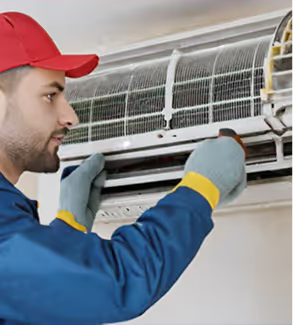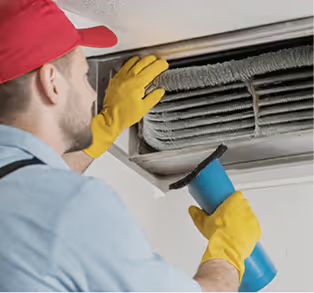


Portage, MI homeowners can improve indoor air quality through professional home air filtration. This page outlines filtration options (HEPA, activated carbon, whole-house filters, portable purifiers), how tests assess pollutants, sizing guidance for whole-house vs portable units, and the role of professional installation in achieving proper airflow and avoiding leaks. It also covers maintenance schedules, warranties, common issues, and FAQs to help choose the right system, ensure proper operation, and protect HVAC performance. Guidance emphasizes pollen season, wildfire smoke, and local building layouts.
.jpeg)
Best Home Air Filteration in Portage, MI
Indoor air quality directly affects comfort, health, and HVAC performance in Portage, MI homes. Whether you live near busy streets, in older houses with dusty ductwork, or close to parks and deciduous tree lines that fuel spring pollen, the right home air filtration system reduces allergens, removes odors and VOCs, and helps family members with asthma or allergies breathe easier. This page explains the most effective systems, how we evaluate needs, and what to expect from professional selection, installation, and maintenance in Portage, MI.
Why home air filtration matters in Portage, MI
Portage experiences high pollen counts in spring, humid summers that encourage mold growth, and cold winters when homes are closed up and indoor pollutants concentrate. Local mills, lawns, and seasonal yard work add intermittent dust and particulates. Proper filtration:
- Reduces airborne allergens (pollen, pet dander, dust mite fragments)
- Lowers particulate matter (PM2.5 and PM10) from outdoor infiltration and indoor activities
- Adsorbs odors and volatile organic compounds (VOCs) from cleaning products and paints
- Helps households with asthma and allergies by removing common triggers
- Improves HVAC longevity by keeping system components cleaner
Common home air filtration systems we assess and offer
Understanding system types helps match solutions to your home's specific needs.
- HEPA (high-efficiency particulate air) systems
- True HEPA captures 99.97% of particles down to 0.3 microns. Ideal for allergy and asthma relief.
- Available as portable units or integrated into whole-house systems via special housings.
- Activated carbon filtration
- Targets odors, smoke, and many VOCs. Often paired with HEPA to provide both particulate and gas-phase removal.
- Whole-house HVAC filters
- High-MERV media filters (MERV 8–13) or electronic/true HEPA installations designed for forced-air systems.
- Provides continuous filtration for every room when properly sized and installed.
- Portable air purifiers
- Best for targeted rooms (bedrooms, living rooms). Look at CADR and room coverage to match Portage room sizes and use patterns.
Indoor air quality testing and assessment
A professional assessment identifies pollutants, sources, and the right technology:
- Visual inspection of HVAC system and ductwork for leaks, dust buildup, and microbial growth
- Particle measurement (PM2.5/PM10) with particle counters
- VOC screening and potential formaldehyde checks where recent renovations exist
- Humidity measurement to assess mold risk and need for dehumidification
- Air exchange and ventilation evaluation to recommend filtration plus ventilation balance
Testing pinpoints whether a whole-house upgrade, targeted portable units, or a combination is the most effective approach for a Portage home.
System selection and sizing guidance
Proper sizing is essential to get the promised performance:
- For whole-house systems: match filter performance to HVAC airflow (CFM) and consider static pressure impacts before selecting high-MERV or HEPA integrations.
- For portable units: choose based on CADR and recommended room square footage. Aim for at least 4–6 air changes per hour (ACH) in bedrooms and high-use living areas for allergy relief.
- Consider home layout: open floor plans, multiple levels, and closed-off rooms influence the number and placement of purifiers.
- Account for local conditions: during spring pollen season or wildfire smoke periods, prioritize higher CADR and HEPA-level particulate capture.
Professional installation and setup
Professional installation ensures filtration works as intended:
- Whole-house installations may require filter housings that accommodate higher-efficiency media without overloading the blower. Technicians measure static pressure and adjust blower settings if needed.
- Duct sealing is often recommended to prevent unfiltered outdoor air from bypassing the system, especially in older Portage homes with attic or basement duct runs.
- Portable unit placement follows airflow patterns and occupant use. Bedrooms typically need dedicated units for nighttime relief.
- Setup includes verifying ACH targets, confirming sealed return pathways, and calibrating any integrated sensors or controls.
Routine maintenance and filter replacement schedules
Maintenance keeps systems effective and protects HVAC equipment:
- Standard MERV media filters: inspect every 1–3 months; typical replacement every 3–12 months depending on load and MERV rating.
- Whole-house HEPA or high-efficiency media: replacement intervals vary; expect inspection semiannually and replacement at manufacturer intervals to avoid pressure drop.
- Activated carbon stages: typically replaced every 3–12 months depending on VOC/odor load.
- Portable HEPA units: prefilters cleaned monthly; HEPA cartridges usually replaced every 6–12 months based on usage and pollution levels.
- Annual HVAC and duct inspections help identify issues early—especially important after Portage’s pollen season and before heating season.
Warranties, certifications, and quality indicators
When evaluating equipment, look for credible standards and protections:
- HEPA: look for certified HEPA performance (99.97% at 0.3 microns)
- MERV ratings: higher MERV (11–13) balances filtration and airflow for many homes; very high MERV may require system modifications
- Certifications: AHRI, UL, ENERGY STAR (for energy efficiency), and independent CADR testing for portable units
- Warranties: equipment warranties typically cover motors and housings; filter life and replacement schedules are outlined by manufacturers—keep documentation for service and claims
Typical issues and how they’re resolved
Common problems Portage homeowners encounter and typical professional responses:
- Reduced HVAC airflow after upgrading to higher-MERV media: resolve by checking static pressure, upgrading blower or using staged filtration.
- Persistent odors despite filters: add or refresh activated carbon stages and address source control (e.g., ventilation, removal of odor sources).
- Excess humidity and mold growth: combine filtration with dehumidification and targeted cleaning of affected ductwork.
- Inconsistent room performance: optimize zoning, add portable units in problem rooms, and seal leaks.
Frequently asked questions (FAQ)
Q: Which system is best for allergies and asthma?A: True HEPA filtration combined with source control and proper ventilation is most effective. For whole-house coverage, a properly integrated HEPA or high-MERV system plus portable HEPA units in bedrooms is common.
Q: Should I choose whole-house filtration or portable units?A: Whole-house systems protect all rooms and are ideal if you use forced-air heating/cooling. Portable units are cost-effective for targeted relief in specific rooms or rentals.
Q: How often should filters be replaced?A: Varies by system and local pollutant load. Inspect monthly; many filters require replacement every 3–12 months. Activated carbon and HEPA cartridges often need replacement every 6–12 months.
Q: Will a high-efficiency filter make my HVAC work harder?A: It can if static pressure is not evaluated. Professionals assess your system and recommend appropriate filters or blower adjustments to maintain airflow.
Q: Can filtration handle smoke or wildfire haze?A: HEPA plus activated carbon is effective at removing particulate smoke and many odor/VOC components. Increase ACH and use portable units in occupied rooms during smoke events.
ConclusionChoosing the best home air filtration in Portage, MI means matching the right technology to your home size, HVAC system, and seasonal pollutant challenges. With focused testing, correct sizing, professional installation, and a clear maintenance plan, you can reduce allergens, control odors, and improve overall indoor air quality for healthier living in Portage homes.
Customer Testimonials

In the past 18 months, Adams has installed a new Amana air conditioning system, and new filtration and humidification systems at my home. The installers were all very courteous, professional and knowledgeable. Their work was simply superb... reasonably priced, and performed on time and to perfection! I enthusiastically recommend Adams, without reservation!
As usual, Adams Heating and Cooling exceeded our expectations. The quote was done in a timely manner, pricing was fair, installation was quick and the job was done right! Rob is great to work with. Adams is first on our list!
Called these guys off of a referral from a friend. Home furnace failure in sub-zero temperatures, late at night. Dan was there in an hour. Friendly, polite, professional and most importantly, very competent. Diagnosed and fixed the problem in under an hour. After hours 24/7 pricing was surprisingly reasonable. This outfit gets straight A+ from us.
Excellent service! We had them replace our heater, AC, and water heater as a package deal. They even helped with financing as it was a large expense to address at one time. It left us with peace of mind that all the mechanicals in our home were new!
They have always been there for us and did so again by responding quickly to put in a new furnace after a lighting strike caused a power surge. In addition, their electrician came by to help with other issues caused by the strike. Everyone we work with from the who answers the phone to who shows up to complete the work are polite, pleasant and professional! And quick to respond and on time!
From the service call to the installation with Dan, Dave, and Daniel… our experience was top notch. They quickly came out, identified the problem, and installation of our new unit took less than 3 hours. Can’t recommend Adams enough!
Dan, Dave and Mike were phenomenal! Very patient, listened to my questions/concerns, and made sure that everything was working and that my Nest was working correctly, before leaving. Thank you so much for your service!
Service was excellent! Had a new furnace installed. The technicians did a wonderful job and completed the installation quickly. Mike answered my questions and followed up to verify the worke done. I was charged just as I was quoted. Have used Adam's for repairs in the past and I'm always pleased. Great work!
I had a boiler and water heater replacement/upgrade. I went from an 84% efficient boiler to a 95% efficient. I dont recall the water heater's efficiency. That was upgraded to an indirect water heater. Josh and Brad did a great job. The work looks great. The boiler and water heater work as to be expected. Their customer service is excellent. I will definitely be calling then when my basement remodel is ready to start.
I have had Adam's Heating and Cooling out at my house before, so I called them for some gas line work. The estimator was very helpful and let me know the best way to be ready for when the work is scheduled so they can test the generator after they install the gas line to the meter and also let me know how to take care of another issue I had that would be helpful. I look forward to getting this work done and working with them.

Financing
Flexible financing options are available to help you get the comfort you need without the upfront financial stress.